$OKTA’s future growth may hinge on GenAI
$OKTA - Excerpt from Tilden’s Q2 2025 Letter (Investor Letters)
Our Q1 2024 investor letter covered the initial investment thesis on Okta. In this letter, we cover how the thesis has played out better than expected. Since it was introduced to the portfolio, Okta has created greater operating leverage in its business than anticipated, and its new products, like IGA, have gained better traction. As a result, Okta, a top-three holding in the 2022 portfolio, has doubled in value over the last three years.
That said, management missteps and a 2023 cybersecurity attack haven’t made it easy for us, prompting us to revisit our investment thesis before deciding whether to continue holding Okta.
Looking forward, Okta’s growth will depend on how successful the company is in getting developers to adopt its Auth0 product for GenAI and whether it can reignite the growth in its core access management business despite competitive challenges from Microsoft’s solution.
Background
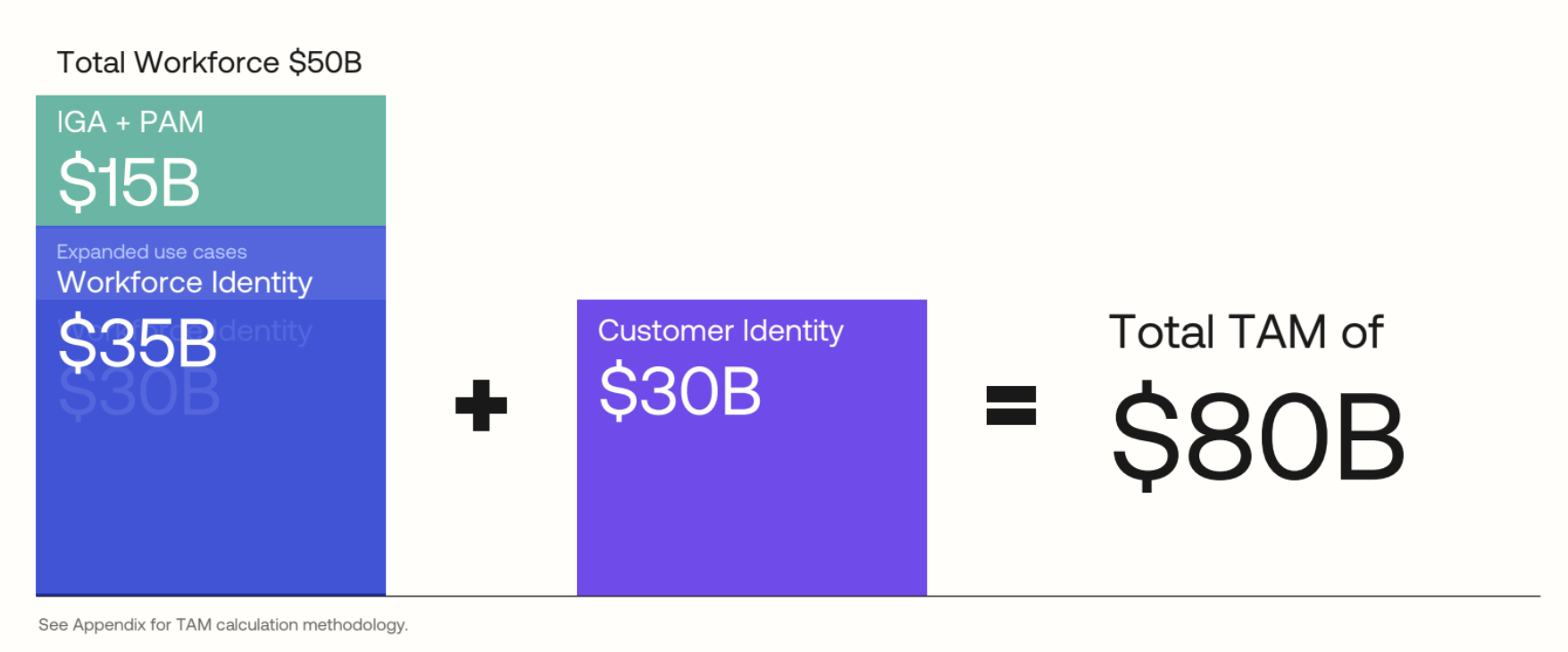
Okta has two main product segments: Auth0 (Customer Identity Access Management) and its home-grown Workforce Identity Management. Customer Identity helps businesses manage customer identities, and Workforce helps businesses manage employee access. In the Q2 FY 2022 call, Okta shared this slide about its addressable market.
Customer Identity Access Management (CIAM)
Okta acquired Auth0 in 2022 for $6.5B. The acquisition was expensive (see valuation discussion). However, it was a good strategic decision that expanded Okta’s total addressable market and exposed it to a developer-driven go-to-market (GTM) motion. The companies had different GTM strategies but complementary products:
Okta = top-down, IT-driven, workforce-focused.
Auth0 = bottom-up, developer-driven, app/customer identity-focused.
Workforce Identity Management product
For its core Workforce Identity Management segment, Okta is expanding into adjacent markets, where its market leadership in access management and ecosystem strength - through 7,000 ecosystem integrations - makes it easier to expand into new markets. These include Identity Governance (a $7.1 billion market in 2023 growing at a 10-year CAGR of 14.24%) and the Privileged Access Management market (a $3.28B market in 2023 growing at a 10-year CAGR of 21.4%).
Follow-up on Initial Investment Thesis
Okta was purchased at an attractive valuation in September 2022 (EV/Sales 5.2x for the next 12 months). Our initial investment in Okta was based on the hypothesis that 1) Focusing on operational efficiency would increase Okta’s margins, and 2) Okta’s comprehensive identity platform would take shape through sales of new products. Furthermore, Okta’s strong Durable Growth Scores for ‘Switching Costs’ (4/5) and ‘Ecosystem Strength’ (4/5) gave us confidence that Okta’s core access management would remain intact.
Okta’s expansion into adjacent products and identity platform development
Okta launched its Identity Governance (IGA) product in 2022, and within three years, it has become a new $100M business for Okta. Large enterprise customers are adopting Okta’s IGA product. Okta launched its foray into Privileged Access Management in 2024, and management believes this will contribute positively to Okta’s growth, just as IGA did.
More importantly, Okta’s ambitions to create a comprehensive Identity Platform are taking shape. Here is Todd McKinnon, the CEO, on the Q1 FY 26 earnings call: “No one has access management, governance, privileged access management, posture management, device access, threat protection, and on and on and on. Plus, none of them are integrated like we are, with 8,000 integrations and all the work we've done there, leading the industry in this march toward independent neutral identity”.
Okta’s improving operating margins
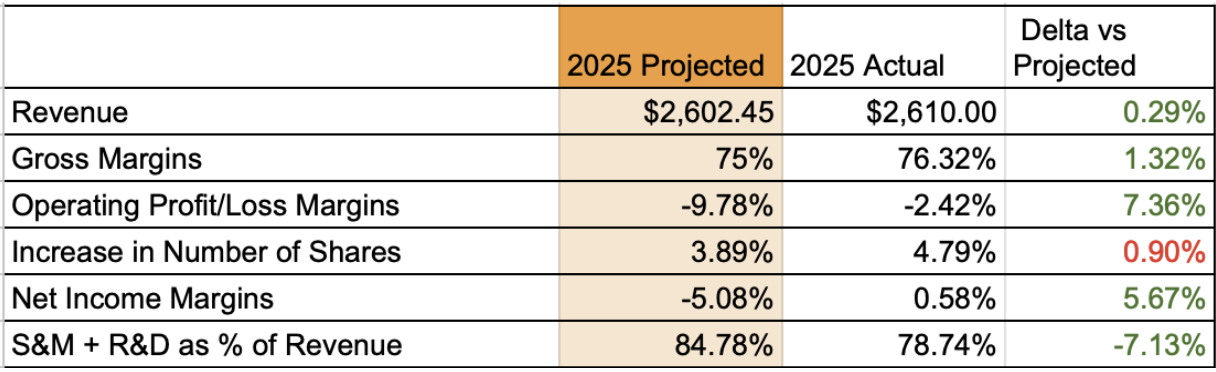
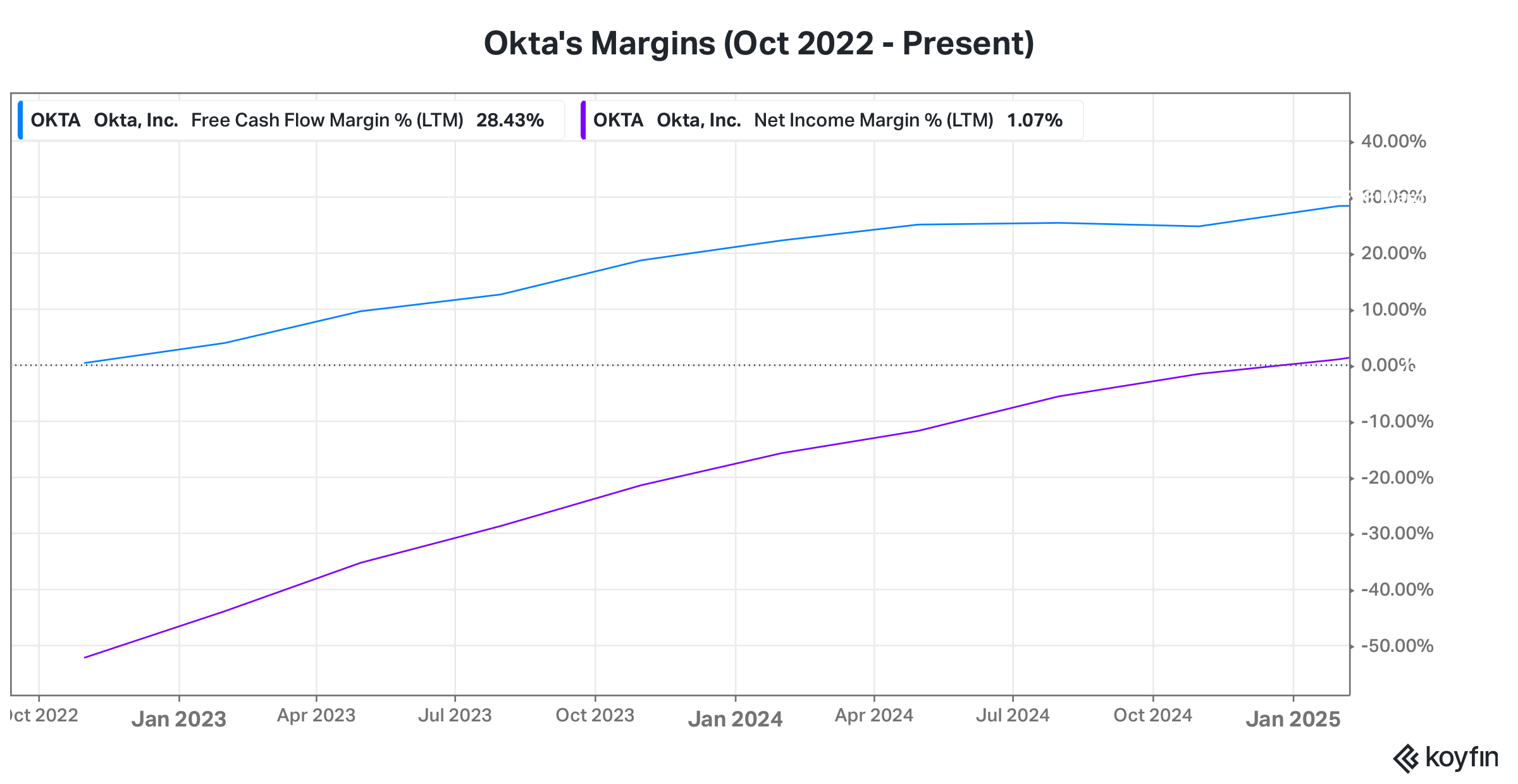
As you can see from the data below, Okta’s operational improvements are running ahead of schedule compared to our 2022 projections. Since October 2022, its GAAP free cash flow margins have increased from 0.4% to 28.5% and net income from -57% to +1%.
Why Tilden held on to the stock despite 2023 cybersecurity hack
Okta suffered a cybersecurity hack in October 2023 (one year after we had originally purchased the stock), which gave us pause. Additionally, some executive departures and sales organization issues made us question management’s competence.
However, Tilden continued to hold the stock because of its cheap valuation, high Durable Growth Score, and management’s openness and transparency during the November 2023 earnings call. Okta conducts its quarterly calls via video, allowing us to better understand management’s thought processes and thus make more informed decisions. Though we still had reservations, Tilden decided to hold onto the stock because CEO Todd McKinnon acknowledged management’s mistakes and took concrete steps to resolve the challenges.
Okta’s Future Prospects
As patient investors, we are willing to ride out short-term challenges if we believe the company’s future growth prospects remain attractive. The ultimate determinant of whether Tilden will continue to hold Okta will be management’s ability to generate sustainable growth.
Slowing growth: growth rates have declined to 15% in FY 2025
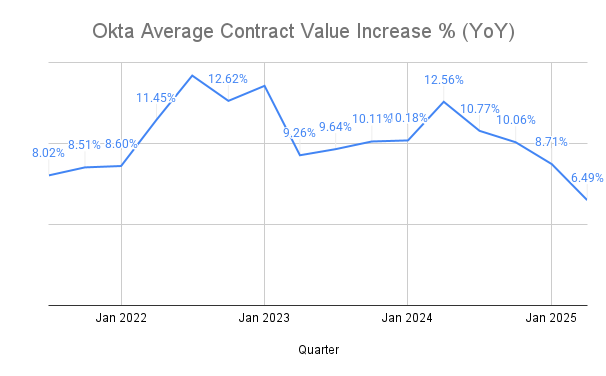
While Okta has expanded into new product areas like IGA, its growth rate has slowed from +40% post-pandemic to 15% in the recent calendar year. The graph below shows a decline in average contract values.
What is behind Okta’s slower growth?
Headwinds from the seat-based pricing model
Okta’s pricing model is seat-based, which translates to the number of employees for its core workforce identity management business. Part of the slower growth stems from companies not hiring as many people as they did during the pandemic, and the growth rate in information technology and business professional jobs has been flat.
Competition from Microsoft
Microsoft’s bundling strategy has impacted several smaller SaaS companies, including Zoom. Okta faces similar pressure. Okta is the preferred platform for customers who are happy to use a mix of Microsoft and other solutions. However, businesses that rely exclusively on Microsoft prefer the Microsoft Active Directory solution.
What Will Revive Okta’s Growth Prospects?
Given that Okta’s core IAM, and CIAM market is projected to grow by ~15%, it’s reasonable to assume a 15% annual growth estimate for Okta overall. However, to boost its growth rate to at least 20%, Okta will need a faster growth rate in the white collar workforce. The major optionality is how Okta will capitalize on the GenAI phenomenon, which may create new use cases and, like the Internet, result in hundreds of new apps that need identity solutions.
Workforce Identity Management - growth in new products for IGA and PAM
Identity Governance (IGA) and Privileged Access Management (PAM) contribute an estimated 5% of Okta’s current revenue. Thus, even if these new products grow at rates exceeding 20%, Okta's overall growth rate will not be significantly impacted in the near term. However, this positions Okta well for long-term growth as these adjacent markets continue to grow.
Okta’s GenAI strategy and Auth0
As mentioned earlier, Okta’s Auth0 is a developer-focused product, whereas its traditional Workforce Identity product focuses on providing solutions to IT administrators. Okta has strategically leveraged Auth0’s developer-centric capabilities to build GenAI capabilities for both B2B (Workforce Identity) and B2C (Customer Identity) use cases. Auth0 is already a leader in CIAM, giving it a good beachhead for capturing GenAI sector growth potential.
GenAI is no longer just about LLMs, like ChatGPT answering questions. GenAI-powered agents are proving successful in B2B cases, such as customer support. Agentforce by Salesforce intends to replace manual labor in areas like customer service, sales prospecting, and sales execution. With the advent of the Model Context Protocol standard, which allows AI agents to get context and data from apps like Slack, the future lies in an interconnected array of agents that may work independently or together to automate business workflows from payroll to customer success.
An army of enterprise AI agents will pose data security challenges, ensuring both who the AI agent, aka user, is and whether the AI agent is authorized to access data. Without proper identity controls, the risks include
Impersonation (agents impersonating other agents)
Data leakage (agents accessing unauthorized data),
Privilege escalation (agents acting outside their scope)
Compliance violations (agents accessing data that violates HIPAA and GDPR)
Therefore, identity becomes critical in the era of non-human identities (AI Agents), and Auth0 has launched an Auth for GenAI product to provide identity controls that allow for:
Authorization of Users or AI Agents
Calling APIs on Users’ Behalf: AI agents connect to far more apps
Authorization for Retrieval Augmented Segmentation (RAG): Data retrieved via RAG must be data that the user is permitted to access.
Async Interactions: AI agents may work in the background for hours/days.
New pricing model based on outcomes; workflows may increase revenue per customer
As discussed earlier, Okta’s growth has been constrained by slow hiring growth, but GenAI will lead to non-human identities, like AI agents, doing more of the work. The pricing model in the GenAI era for SaaS applications will likely shift toward outcome-based pricing (number of customer tickets solved) or workflow-based pricing (number of customer tickets triaged).
Okta is considering a new pricing model for GenAI use cases. The explosion of AI agents will significantly increase the number of workflows and outcomes, potentially increasing Okta’s revenue per customer.
Valuation: Relatively Cheap, Upside depends on Growth
A core investment principle for Tilden is finding companies with well-architected products, attractive financial profiles that provide investors with a comfortable margin of safety, and market-beating long-term growth potential.
Okta’s management has made a prudent bet on expanded margins and focused on delivering profitable growth. As of the recent quarter, the company’s free cash flow (FCF) margin of 28.5% and growth rate of 15.3% give it a score of 42 on the Rule of 40. Some of Okta’s challenges that resulted in negative margins were self-inflicted, including the Auth0 acquisition, which was acquired using Okta stock. This led to stock-based compensation (SBC) expenses as a percentage of revenue jumping from 23% in April 2021 to 43% in April 2022, before dropping back to 20.2% in April 2025.
Okta’s management has done an excellent job exercising operating leverage to boost FCF and achieve GAAP-positive net income margins. We believe the sticky nature of Okta’s business will help it continue to expand operating margins. Comparing Okta to Veeva, which has a similar revenue of $2.8B to Okta’s $2.6B, Veeva has GAAP operating margins of approximately 27% while Okta’s are only 0.60%, giving Okta ample opportunity to continue growing its margins.
As of June 30, 2025, Okta traded at a relatively cheap valuation of 5.3x Enterprise Value/ Sales for the next twelve months and a maximum of 7.2x on EV/NTM sales over the last 12 months - most recently in May. Thus, Okta offers investors decent short-term upside potential.
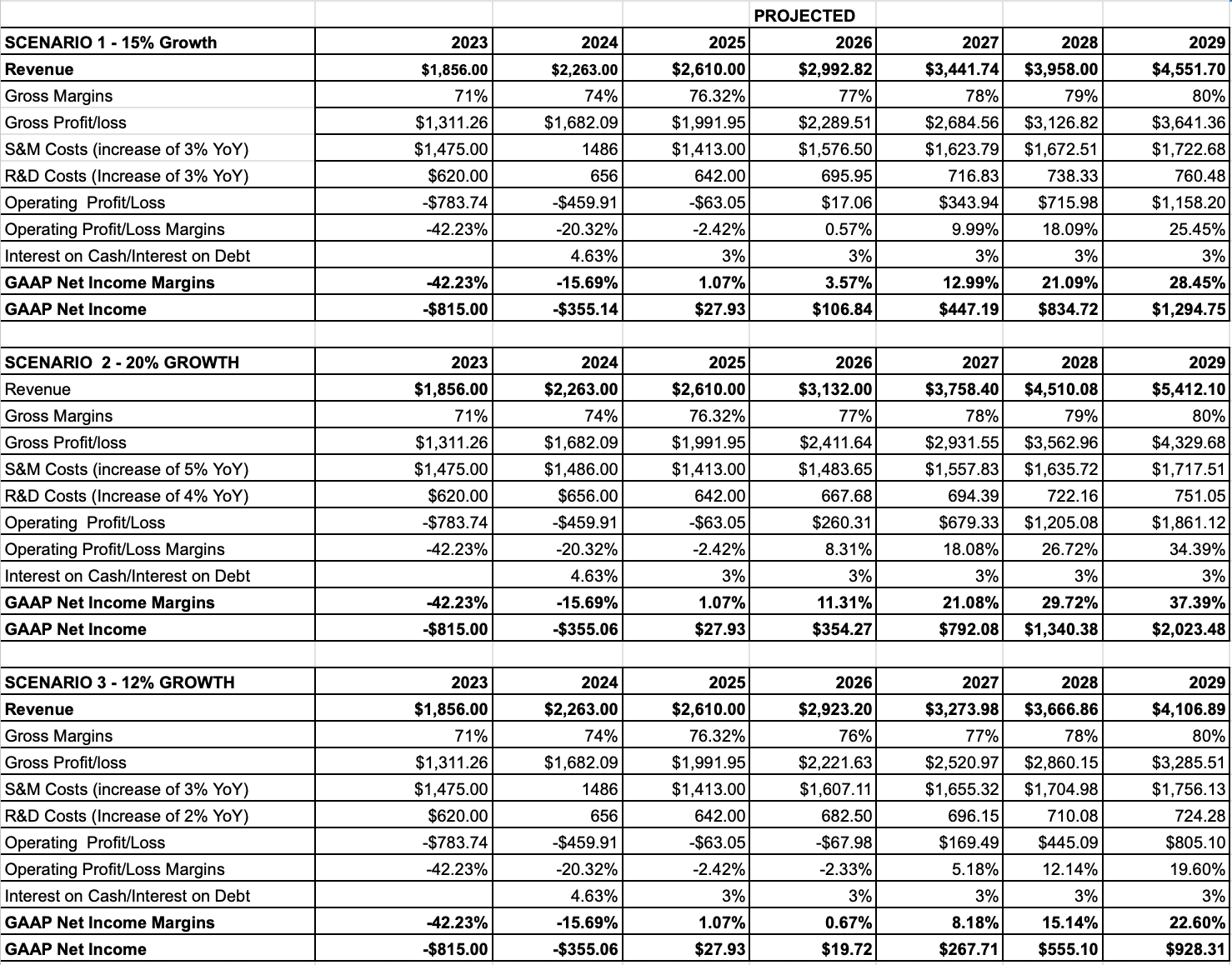
That said, Tilden’s approach is to look three to five years into the future. Achieving the same success as we have in the past - namely, a 100% gain in three years for our initial purchase - will depend on future Okta revenue growth rates. As discussed in the previous section, Okta will need to capitalize on GenAI’s potential to achieve 20% growth. If it doesn’t, growth will continue in the low-to-mid-teens. Annual revenue growth of 12% to 20% would result in $4.1B to $5.4B in revenue by 2029. Okta’s Gross Margins are projected to expand from 76% in 2025 to 80% in 2029. The share count is projected to increase by 3% annually to reach 197M shares in 2029.
Based on our estimates of a 3% to 5% increase in research and development (R&D) and sales and marketing (S&M) costs, while applying a P/E range of 25 to 35 times, we get to a market cap of between $24B and $71B in 2029. Assuming 197m outstanding shares at our 15% growth base case, we estimate a market cap of $32B to $45B, and get to a price target of $164 to $230. This represents an increase in Okta’s share price of between 64% and 132% by 2029. A 12% growth rate would yield a smaller upside, and a 20% growth rate a bigger upside.
Tilden’s first purchase of Okta stock was in September 2022 at approximately $56. We added further exposure at $70 in October 2023 (at the time of the cybersecurity hack) and bought again at approximately $80 in October 2024. We sold a portion of the holding in March 2025 at approximately $115. This trading history demonstrates our conviction in the long-term thesis while taking advantage of market volatility.
Key takeaways
In an era where identity has become the last line of defense against cybersecurity threats, we believe Okta has a strong chance of remaining at the center of an industry that controls access to the applications and data that power modern business. Whether it can resume its 20%+ growth rate may depend on how it leverages the GenAI phenomenon.
Estimates for Okta’s Income Statements
The spreadsheet below includes estimates for Okta’s income statements for the following scenarios: 15% (base case), 20% and 12% CAGR growth rates between 2026-2029. The base case assumes a 15% growth rate until 2029.
—----------------
Disclaimer
Past performance is no guarantee of future returns.
Not Investment Advice. All investing involves risk and possible loss of principal.
In the analysis, we use third-party resources we believe to be reliable, but cannot guarantee the accuracy of such information. We believe the information we provide is accurate as of the date furnished, but we do not revisit past material to update it.