Four Years of Tilden Path: Lessons in Patient Conviction
As we marked Tilden Path's four-year anniversary in September, we wanted to revisit what we have learned over our journey. Tilden Path started in 2022 with a fundamental belief: evaluating product quality can help identify long-term winners in small- and mid-cap tech. Over the past four years, that conviction was tested, first by investors' preference for the Magnificent Seven and lately by their aversion to software.
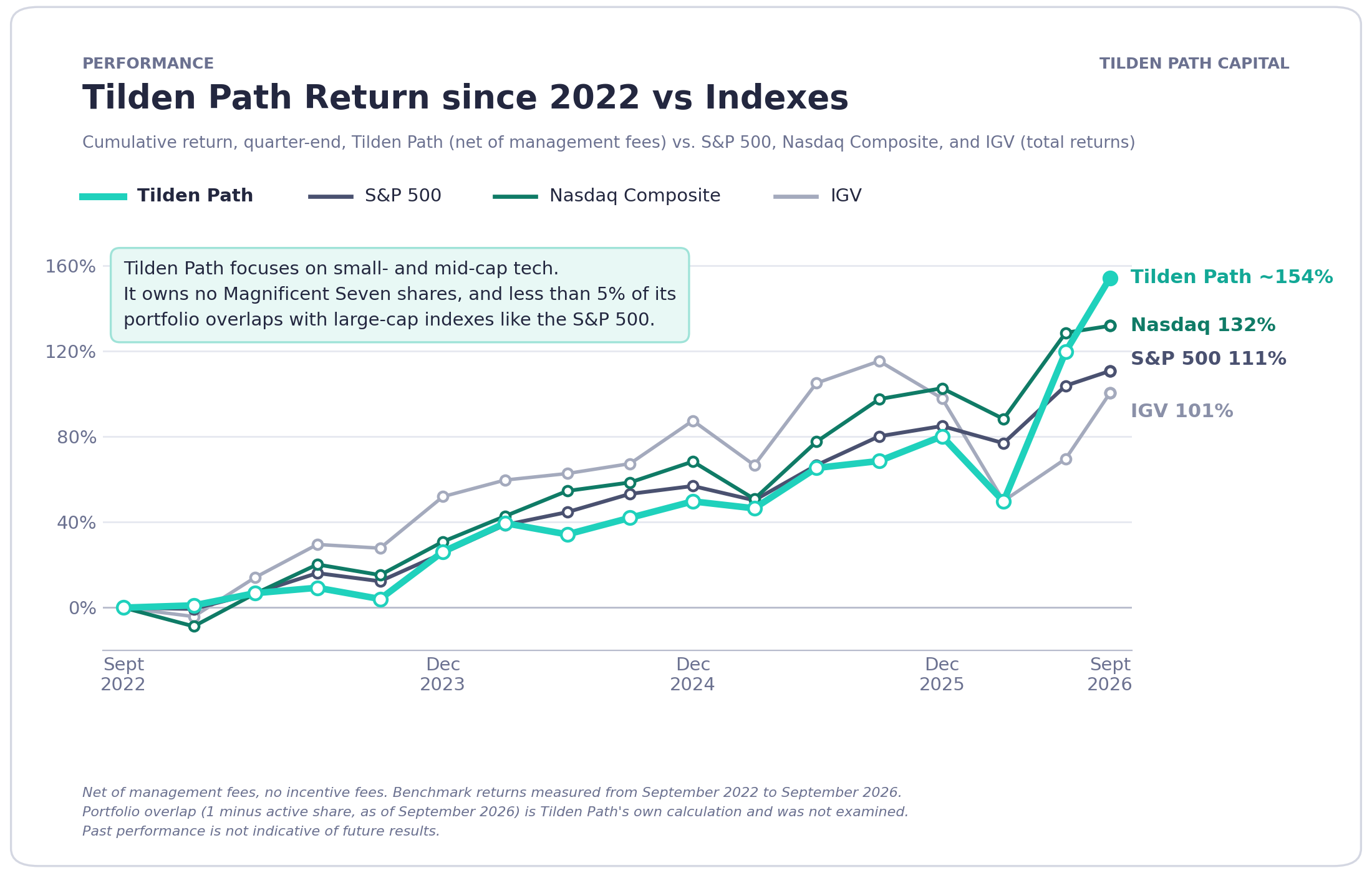
We stuck to our beliefs, and Tilden Path returned about 154% net of fees over four years, about 26.6% annualized. The software index (IGV), the closest match to what we own, returned about 101%, or 19.2% a year. The S&P 500 returned about 111%, or 20.7% a year, and the Nasdaq Composite about 132%, or 23.7% a year. An independent PCAOB-registered CPA firm examined our results, and its report is available on request. We achieved these results owning no shares of the Magnificent Seven and with minimal exposure to the large-cap indexes: as of September 2026, our active share was above 95% against both the S&P 500 and the Nasdaq-100.
What We Have Learned
The four-year report card says our strategy of buying superior products at reasonable prices, evaluated through our Durable Growth Score, is working. We buy companies whose products are tough to replicate and tough to switch away from, led by management capable of innovating through disruption. Well-designed products are like well-designed architecture, Florence's Duomo for example: they become more recognized for their elegance with time.
Patient conviction is the engine of this strategy. Our ten biggest winners have produced about 90% of our gross gains. Without exception, each was either out of favor or undiscovered at the time of purchase. It took the market 18 to 36 months to recognize our smaller portfolio companies like DigitalOcean, Twilio, and Okta. We expect outperformance to be uneven, arriving in some years and not others. Short-term ups and downs in performance help us sharpen our process rather than drive immediate repositioning. Two of our ten biggest winners, Adyen and Toast, have faced meaningful headwinds recently. For each of them, we continuously evaluate whether this is a temporary dislocation in price or a structural shift in the thesis that calls for action.
Three examples. We bought DigitalOcean, Twilio, and Okta in 2022, when each was unloved. DigitalOcean had fallen roughly 80% on fears that a small cloud provider couldn't compete with AWS. Developers chose it for its simplicity, and new management in 2024 extended its capabilities into adjacencies and AI. Twilio had fallen more than 80% as the market saw a messaging company being commoditized. We saw communications infrastructure embedded in customers' applications, expensive to rip out, that could get a tailwind from voice AI apps. It did. Okta was beaten down, but our core belief that identity management is central to security bore fruit, with Okta recently benefiting from the rise of AI agents. Each earned little through 2024. Most of the gains came in 2025 and 2026.
Not everything worked out, but we adjusted. Trade Desk was our largest loss. The ad tech industry is going through changes due to the advent of AI platforms and the decline of the open web relative to closed gardens. Moreover, management's apparently irrational steps motivated us to take our losses in May 2026.
What's next. We have learned the importance of sector diversification. We have already moved into semiconductors and industrial automation, and we are researching space tech, defense tech, robotics, and other emerging tech ecosystems. We also don't see software as a single bucket: we treat application software, infrastructure software, and cybersecurity separately. Position sizing is another lesson. We constantly evaluate position sizes, increasing or reducing them to limit downside and volatility in returns.
Thank you for four years of trust, and for following Tilden Path's journey. If you would like to discuss Tilden Path’s investing approach or exchange notes, please reach out at gaurav [at] tildenpathcapital [dot] com.
Disclaimer
Past performance is no guarantee of future returns.
Not Investment Advice. All investing involves risk and possible loss of principal.
Performance shared here belongs to the first client that invested in Tilden’s SMID Tech strategy in 2022.
In the analysis, we use third-party resources we believe to be reliable, but cannot guarantee the accuracy of such information. We believe the information we provide is accurate as of the date furnished, but we do not revisit past material to update it.