DOCN: The “Simple Cloud” Growth Story
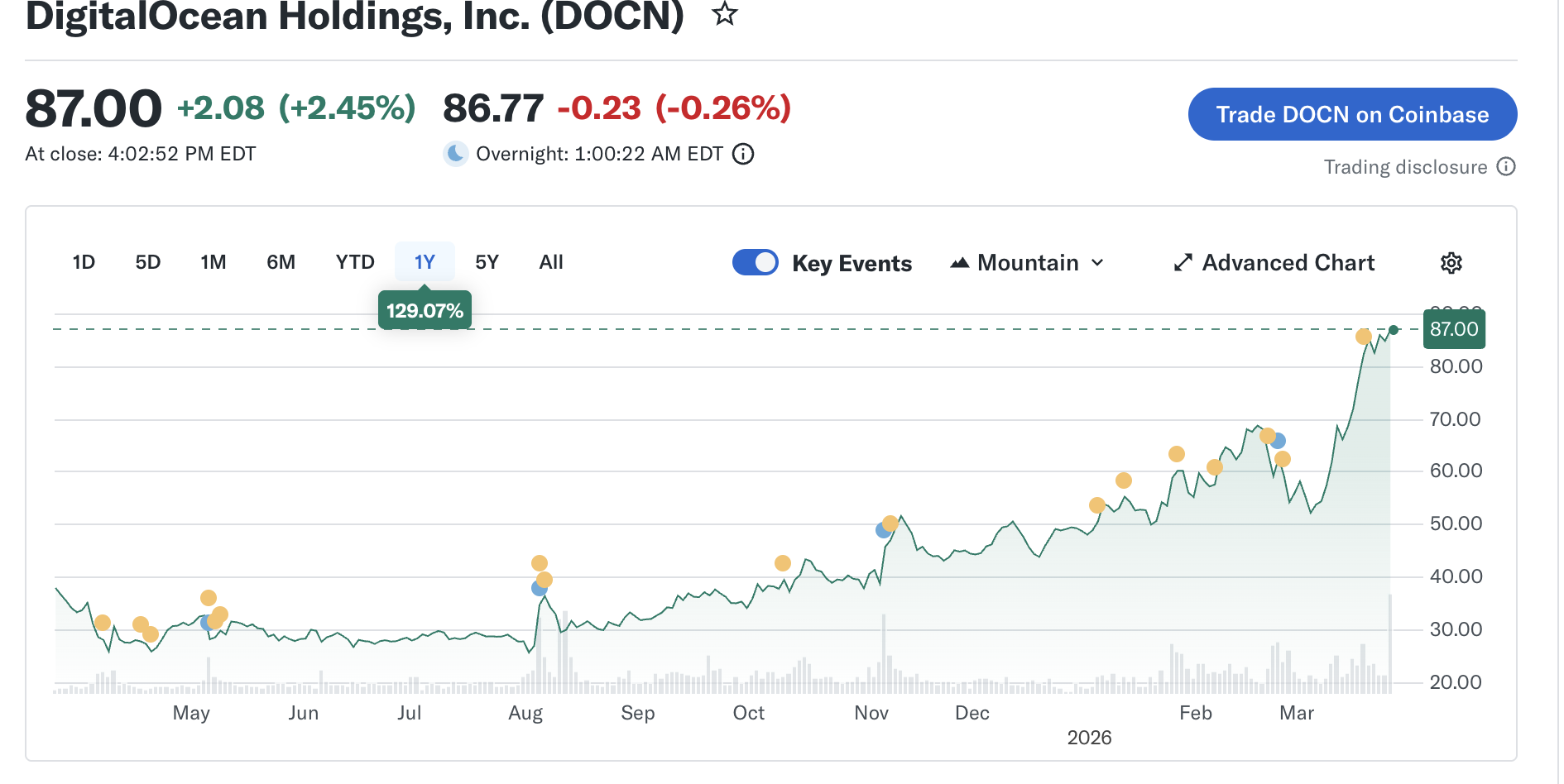
Strong Ecosystem and technology stewardship has led the turnaround.
Following is an excerpt from TIlden Path’s Q3 2025 Investor Letter. Tilden's first purchase of DigitalOcean was a relatively small position in December 2022 at ~$29. Further purchases were made in October 2023 at $24, and in May 2024 at ~$34. Additional major purchases were made in May 2025 at ~$28. Excited to share our thesis here:
Discussion of Portfolio Holding – DigitalOcean
DigitalOcean (NYSE: DOCN): The "Simple Cloud" Growth Story
DigitalOcean is a cloud IaaS and PaaS provider with a $4.5B market cap, specifically tailored for developers and SMBs. The company has earned high customer loyalty by serving as a streamlined alternative to the complexity associated with hyperscalers like AWS and Azure. Despite its small size, DigitalOcean operates 17 data centers across nine regions and serves more than 640,000 customers and 3 million developers across 190 countries.
Tilden chose to invest in DigitalOcean for its compelling valuation, established platform for SMBs, and unique "simplicity moat." The company has cultivated a strong developer community and high switching costs, making it a resilient niche player in a market of giants. After pandemic-era growth decelerated from 30% to the mid-teens, DigitalOcean has successfully re-accelerated under new management focused on disciplined capital allocation and a high-velocity product strategy. This pivot—shifting focus from small companies to "Scalers+" (>$100k ARR) with targeted enterprise-ready features—has revitalized the top line. With accelerating revenue, a best-in-class product-led growth (PLG) engine, and an attractive valuation (20x forward GAAP P/E), DigitalOcean represents an attractive Growth at a Reasonable Price (GARP) opportunity while remaining an appealing acquisition target. DOCN is one of our larger positions, representing more than 5% of the portfolio.
The Simplicity Moat: Why Developers Choose DOCN Over Hyperscalers
DigitalOcean has carved out a high-margin, $800M+ revenue niche by positioning itself as the "Anti-Hyperscaler." While AWS, Azure, and Google Cloud have evolved into complex platforms with 200+ services and opaque billing, DigitalOcean wins on simplicity. For developers at startups and "Scalers+," hyperscalers impose a "tax on time"—requiring dedicated DevOps expertise to navigate dashboards and avoid "bill shock" from hidden egress fees.
Three Pillars of DigitalOcean’s Competitive Differentiation:
1. Simple (Just enough cloud): DigitalOcean doesn't compete on breadth—it offers a "Golden Path" of essential services (Managed Kubernetes, Databases, and their new Unified Agentic Cloud for AI). By offering 80% of what developers need with 10% of the configuration, they allow users to deploy a Droplet in under five minutes.
2. Predictable Economics: Unlike hyperscaler "black box" pricing, DigitalOcean offers flat-rate monthly pricing with bandwidth (egress) included. This eliminates the primary fear for small companies: variable cost spikes when products go viral.
3. Support Advantage: Combined with 24/7 support and an open ecosystem that avoids vendor lock-in, this predictability creates high switching costs despite technical portability.
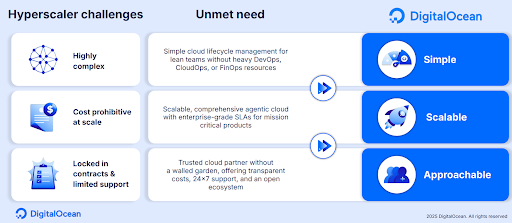
DigitalOcean vs Hyperscalers
Rating DigitalOcean on Tilden Path Capital’s Durable Growth Score
Ecosystem Strength (Durable Score Weighting: 15%, Score: 5/5)
This factor evaluates the depth and "gravity" of a platform’s ecosystem—including third-party developers, open-source contributors, and strategic integrations. A high-scoring ecosystem enables efficient, organic growth by significantly lowering Customer Acquisition Costs (CAC) and drives customer loyalty and expansion resulting in high Net Dollar Retention (NDR).
Community Flywheel: The Self-Reinforcing Product-Led Growth Engine
DigitalOcean's competitive moat is built on a documentation-first community flywheel that generates structural advantages competitors cannot replicate through marketing spend alone. The company's community hub serves as both education platform and acquisition funnel, its 8,000+ tutorial library generating 4 million monthly visitors.
This creates a self-reinforcing cycle: developers searching for "how to deploy Node.js" or "set up PostgreSQL" discover DigitalOcean tutorials that solve their immediate problem while simultaneously onboarding them to the platform. By the time users complete a tutorial, they've already created an account and deployed their first Droplet—turning education into frictionless customer acquisition. The result is 30,000+ monthly customer acquisitions through pure self-service channels, with 98% of customers signing up without sales interaction. The advantage is structural. As more developers use the community, they contribute tutorials, attracting more developers—a network effect that accelerates with scale. AWS or Azure could invest billions attempting to replicate this model, but they cannot purchase years of accumulated community trust and SEO authority that make DigitalOcean tutorials dominate search results. Market penetration validates the strategy's effectiveness: 11% of professional developers actively use DigitalOcean (2025 Stack Overflow survey), representing significant mindshare in a market dominated by hyperscalers 100x its size.
Marketplace and Partner Ecosystem
DigitalOcean's marketplace serves more than 640,000 customers with one-click deployments for popular applications and development stacks. Strategic partnerships, notably the Hatch Startup Program and the AI Startup Ecosystem (via Techstars), provide a direct funnel for high-growth startups to access discounted NVIDIA H100 GPU Droplets and specialized support. These integrations create a "soft lock-in"—while the underlying infrastructure is technically portable, the operational cost of re-configuring a complex, pre-integrated stack elsewhere creates significant inertia and long-term customer stickiness.
Open Ecosystem Paradox: Portability Creates Loyalty
Counterintuitively, DigitalOcean's commitment to open standards strengthens its ecosystem by lowering the "barrier to entry" and the "fear of exit." By avoiding proprietary APIs and walled gardens, the company attracts developers who prioritize technical optionality—creating brand loyalty that transcends architectural lock-in.
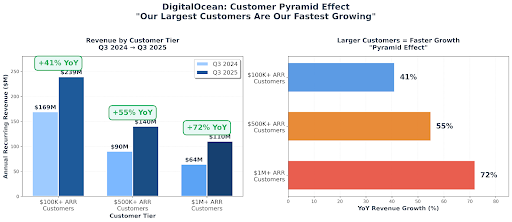
The proof of this "voluntary loyalty" is evident in recent cohort behavior: revenue from Scalers+ ($100k+ ARR) grew 41% year-over-year, while customers with $1M+ ARR surged by 72%. These customers are expanding usage at record rates despite having technical portability to migrate elsewhere. In an industry where hyperscalers retain through complexity and punitive switching costs, DigitalOcean retains through simplicity and transparency—a fundamentally more durable moat in a developer-first market.
Ecosystem Strength leads to Industry-leading Sales and Marketing Efficiency
This community-driven acquisition engine translates directly into unprecedented financial efficiency. DigitalOcean's self-service dominance creates a uniquely lean financial profile, with Sales & Marketing (S&M) spend at just 9% of revenue (FY 2024)—operating more efficiently than cloud infrastructure peers: Datadog (24%), Snowflake (35%), Cloudflare (35%), and MongoDB (38%). Unlike competitors who often "buy" growth through expensive enterprise sales teams, DigitalOcean's community-led engine does the selling, resulting in lower Customer Acquisition Costs (CAC) and higher Lifetime Values (LTV) that compound as the platform matures.
This efficiency advantage is structural, not cyclical. By leveraging its community as a "zero-cost" lead generator, DigitalOcean has maintained S&M spend in the high single to low double digits even while scaling from $200M to $890M+ in projected 2025 revenue. This lean operation provides the capital necessary to maintain a high 43% Adjusted EBITDA margin while simultaneously reinvesting in higher-value R&D—such as GPU capacity and managed AI services. As seen in Q3 2025, this strategy allowed the company to accelerate revenue growth to 16% YoY without the burden of a bloated enterprise sales force.
Technology Stewardship (Durable Score Weighting: 20%, Score: 4/5)
Technology Stewardship evaluates management's ability to be good stewards of the company’s products, navigate inflection points, sustain innovation velocity, and maintain competitive differentiation through product excellence.
Tilden Path increased its investment in DigitalOcean specifically because of the technology stewardship shift and product focus under new CEO Paddy Srinivasan. While the current management team may not be visionaries, they have demonstrated disciplined execution: systematically expanding into adjacent markets, accelerating product velocity, and improving capital allocation. This pragmatic approach aligns with Tilden's preference for companies that compound value through continuous improvement.
The Spruill Era (2019–2024): Financial Engineering Over Product Innovation
Under former CEO Yancey Spruill, DigitalOcean prioritized financial engineering over product development. The company issued $1.5 billion in 0% convertible notes (November 2021) and deployed proceeds into aggressive share buybacks—returning $600 million in 2022 and authorizing another $500 million in 2023. While these repurchases successfully reduced share count, the timing proved problematic: buybacks occurred during peak valuations (near $119 per share) and coincided with decelerating revenue growth (from 30% YoY in Q1 2023 to 11% by Q4 2023).
More critically, capital allocation favored buybacks over R&D at a time when competitors were shipping enterprise features and AI capabilities. Product velocity stagnated—developers noticed. A Hacker News thread following the CEO transition captured the frustration:
"DigitalOcean needs more innovation than anything. I think this is where their current CEO made the biggest mistake. He spent billions in buyback using debt when instead he should have put that money into innovation and growth. They need someone that understands why DigitalOcean is liked by developers. Lately the pace of innovation at DigitalOcean is almost nothing. All of their latest features have been bought. Nimbella for functions. Cloudways for website hosting, and Paperspace for GPUs. They need to go back to focusing on great documentation and building features and tooling to make it even easier for developers to build and scale on their platform."
The critique was accurate: rather than building in-house, Spruill relied on M&A to paper over product gaps, acquiring capabilities (Paperspace for AI/ML, Cloudways for managed hosting) without integrating them into a cohesive platform strategy.
The Srinivasan Era (2024–Present): Focus on Disciplined Product Innovation
Paddy Srinivasan, who joined as CEO in February 2024, immediately pivoted from financial engineering to product innovation. The transformation is quantifiable: by Q2 2025, feature release velocity increased 5x (60+ major releases vs. 12 in the prior year).
The Two-Pillar Product Innovation Strategy: AI and Enterprise Readiness
The CEO focused on two pillars—Agentic Cloud for AI-native workloads and Enterprise Readiness for large customers—to drive growth in the Scalers+ ($100k+ ARR) segment.
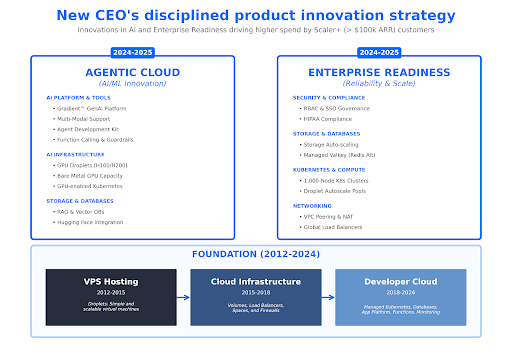
The AI Transformation: Srinivasan inherited the Paperspace acquisition but executed what Spruill could not—rapid commercialization. In October 2024, DigitalOcean launched GPU Droplets with democratized access to NVIDIA H100/H200 GPUs and shipped the Gradient AI Platform for deploying AI agents and fine-tuning models. AI/ML revenue has since doubled year-over-year for five consecutive quarters, validating the go-to-market execution.
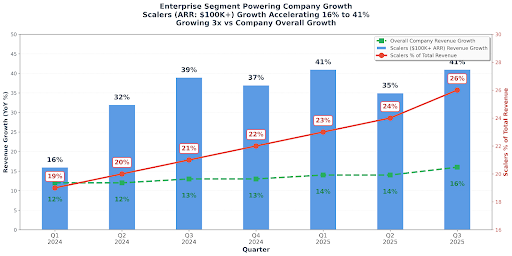
Enterprise Readiness: Recognizing that growth required moving upmarket, Srinivasan systematically closed feature gaps that had prevented enterprise adoption: Global Load Balancers, Role-Based Access Control (RBAC), VPC Peering, HIPAA compliance, enhanced backups, and advanced observability. These weren't flashy launches—they were table stakes for competing in the Scalers+ segment ($100k+ ARR), which accelerated from 16% YoY growth in Q1 2024 to 41% by Q3 2025 and now represents 26% of revenue.
Capital Allocation Reset: Debt for Growth, Not Financial Engineering
Srinivasan's capital allocation philosophy diverges sharply from his predecessor's. In August 2025, DigitalOcean issued $625 million in 2030 convertible notes—but the objective was balance sheet optimization, not buybacks. The proceeds refinanced Spruill's 2026 debt early, eliminating near-term dilution risk while securing low cash interest expense through 2030. Instead of returning capital to shareholders during a growth inflection, the new management deployed resources toward productive infrastructure: the Atlanta data center (online Q1 2025) and 30 megawatts of incremental capacity secured for 2026+.
Product Focus Drives Revenue Acceleration Led by Larger Customers ($100k ARR+)
The strategy is working: customers spending $500k+ annually grew 55% YoY, while $1M+ customers surged 72% YoY—dramatically outpacing overall company growth of 16%. This "pyramid effect" is visualized in the financial metrics section below, where the data clearly shows that DigitalOcean's largest customers have become its fastest-growing segment.
By systematically closing enterprise gaps while preserving the developer simplicity that built the platform, management has demonstrated the technology stewardship that Tilden values. This includes disciplined execution, strategic capital allocation, and the ability to industrialize a platform without alienating its core user base.
DigitalOcean earns a strong 4/5 score for Technology Stewardship—not for visionary category creation, but for the pragmatic, compounding execution that drives durable growth.
Rating DigitalOcean’s Financial Metrics
In this section, we explore DigitalOcean 's improving financial metrics including revenue growth, improving margins, and better capital allocation.
DigitalOcean’s Revenue Growth is Re-accelerating
Following deceleration from 30% YoY growth in Q1 2023 to 11% by Q4 2023, DigitalOcean has reaccelerated to approximately 15% for full-year 2025.
This inflection is powered by Scalers+ customers ($100k+ ARR), who are growing 41% YoY—nearly 3x faster than the company overall. These high-value customers now represent 26% of total revenue, up from 19% seven quarters ago.
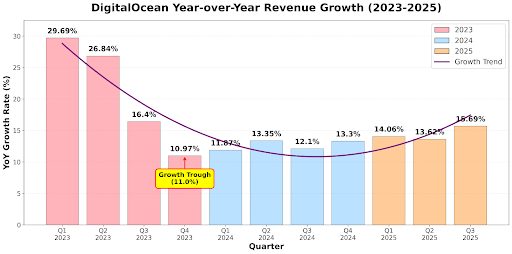
The "pyramid effect" is even more pronounced at the very top: customers spending $500k+ annually grew 55% YoY, while $1M+ customers surged 72% YoY—4.5x faster than overall company growth. This acceleration validates that the enterprise features—are driving expansion within the installed base, not just new logo acquisition. DigitalOcean is successfully moving customers up the pyramid as their workloads scale, capturing mission-critical production deployments that were previously out of reach.
DigitalOcean's Improving Operating Margins
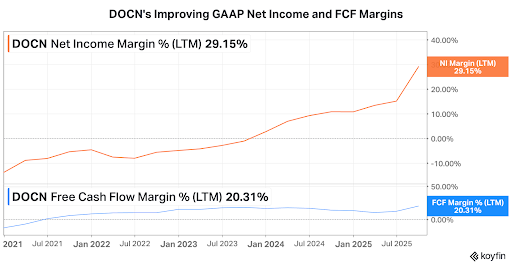
DigitalOcean's margin profile has improved dramatically under new leadership. GAAP Net Income margin has surged to 29.15% (LTM), up from barely profitable levels in 2023, while FCF margin has stabilized around 20%. This profitability inflection reflects the strategic shift toward higher-value Scalers+ customers, which carry better unit economics than the company's legacy "Testers and Learners" segment.
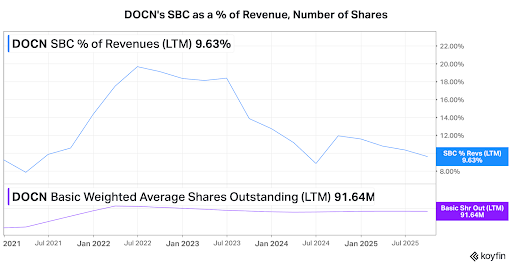
The margin expansion story has multiple drivers. First, Adjusted EBITDA margins have expanded to approximately 41% (guidance for FY 2025: 40.7-41.0%), demonstrating operating leverage as the company scales. Second, Stock-Based Compensation has declined from a peak of ~20% of revenue in mid-2022 to just 9.63% currently—a structural improvement that directly enhances both GAAP and non-GAAP profitability. Third, the shift in customer mix means DigitalOcean is spending less on customer acquisition (S&M efficiency at 9% of revenue) while capturing larger, stickier workloads that generate more revenue per customer.
DigitalOcean’s Reduced SBC and Buybacks Demonstrate Disciplined Capital Allocation
Stock-Based Compensation has declined from approximately 20% of revenue in mid-2022 to 9.63% currently—reflecting more disciplined equity management under new leadership. In August 2025, DigitalOcean issued $625 million in 2030 convertible notes to refinance early its 2026 debt and strengthen the balance sheet. Diluted shares outstanding increased to approximately 106.5M (per FY2025 guidance), reflecting dilution from convertible securities. To offset this, the company authorized a measured $100 million buyback program through July 2027.
This balanced approach contrasts sharply with Spruill's capital allocation. Where Spruill returned $1.1B in buybacks during growth deceleration (30% → 11%), Srinivasan uses convertible debt strategically to refinance obligations and invest in infrastructure during a growth inflection (11% → 16%+).
This combination of declining stock-based compensation, strategic debt management, and measured buybacks demonstrates sustainable value creation rather than financial engineering.
DigitalOcean Valuation Analysis
DigitalOcean's current valuation appears highly compelling when benchmarked against Jamin Ball's Clouded Judgement SaaS data, suggesting the market is undervaluing its reacceleration story and best-in-class unit economics. At an EV/Sales ratio of approximately 5.0-5.5x (reflecting an Enterprise Value of ~$4.2-4.5 billion), DigitalOcean trades at a notable discount to the median mid-growth public SaaS multiple of 6x-7x, despite reaccelerating organic growth to 16% and operating with exceptional efficiency. The value proposition becomes even more attractive when viewing profitability: with 42-43% Adjusted EBITDA margins and ~20% Free Cash Flow margins, the company trades at approximately 20x forward GAAP P/E—well below the Clouded Judgement median of ~30-35x for profitable, growing SaaS peers. While the discount is partially attributable to its infrastructure-heavy model (60% gross margins vs. 70-80% for pure SaaS), the magnitude of the valuation gap appears excessive given the company's improving fundamentals: reaccelerating growth (from 11% trough to 16%), expanding Scalers+ revenue at 41% YoY, industry-leading S&M efficiency (9% of revenue vs. 24-47% for peers), and a best-in-class product-led growth engine generating majority of new customers via self-service adoption.
Estimates for DigitalOcean’s Income Statements
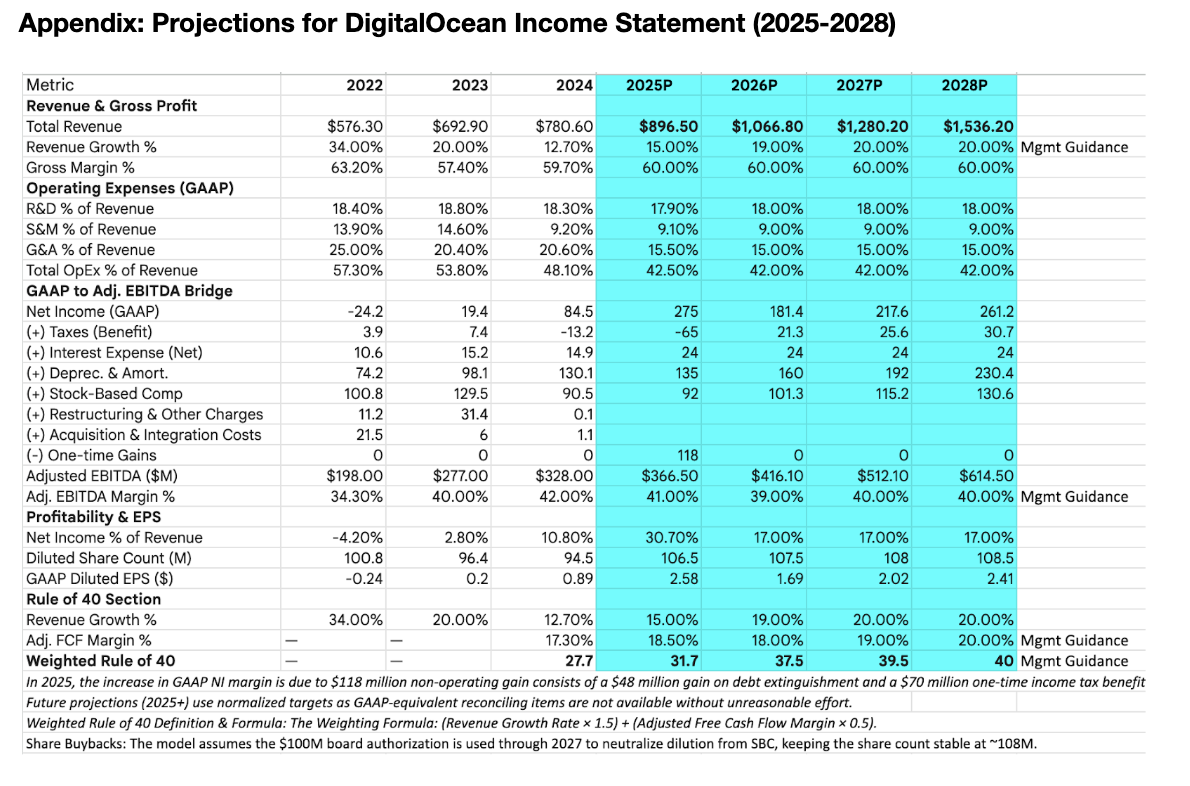
At its 2025 Investor Day, DigitalOcean established a long-term goal to achieve a 40%+ Weighted Rule of 40 score by 2027. Management introduced a strategic weighting of 1.5x for Revenue Growth and 0.5x for Adjusted FCF Margin, signaling that top-line expansion is prioritized 3-to-1 over cash flow. The initial roadmap targeted 18–20% annual revenue growth and mid-to-high teens FCF margins by fiscal year 2027.
Following a record Q3 2025, management accelerated its timeline, now expecting to reach the 18–20% revenue growth target in 2026—one full year ahead of schedule. Full-year 2025 revenue guidance was raised to $896M–$897M (~15% growth), with Adjusted EBITDA margins raised to 41%. This acceleration is underpinned by a 72% revenue surge in $1M+ ARR customers and the deployment of 30 megawatts of new data center capacity to meet surging AI demand.
In August 2025, DigitalOcean issued $625 million in 2030 convertible notes to refinance early its 2026 debt and strengthen the balance sheet. To mitigate dilution from stock-based compensation, the company authorized a $100 million share repurchase program through July 2027, keeping diluted shares relatively stable at 106-108 million through 2028.
Financial Projections & Path to Weighted Rule of 40
Our estimates reflect management's strategic priorities: revenue reacceleration through infrastructure investment, with operating leverage improving margins over time. Key assumptions include:
Revenue Growth: Accelerating from 12.7% (2024) → 15% (2025) → 19% (2026) → 20% (2027-2028), driven by Scalers+ ($100k+ ARR) segment expansion
Adjusted FCF Margin: Improving from 17.3% (2024) → 18.5% (2025) → 20% (2028) as infrastructure investments scale
Weighted Rule of 40: Progressing from 27.7 (2024) → 31.7 (2025) → 40.0 (2028), achieving management's long-term target
Diluted Shares: Projected to remain relatively stable at 106-108M through 2028, as the $100M buyback program (authorized through July 2027) is intended to offset SBC dilution
Note: The 2025 GAAP Net Income margin spike to 30.7% includes a $118 million non-operating gain from debt extinguishment and one-time tax benefits. Normalized Net Income margin is approximately 17%, consistent with 2026-2028 projections.
2027 Valuation Analysis: The Re-Rating Opportunity
To refine the 2027 price target, we have applied Clouded Judgement (Jamin Ball) benchmarks, typically segmenting companies by their "Rule of 40" performance and growth rates.
To calculate the stock price at the end of 2027, we use NTM (Next Twelve Months) estimates, which in this case are 2028 projections.
Valuation Timeframe
Current Price (December 2025): $48
Target Date: December 2027 (2-year horizon)
Valuation Basis: 2028 NTM financials
2028 Baseline (The "NTM" for 2027-End)
NTM Revenue (2028): $1,536.2M
NTM GAAP EPS (2028): $2.42
NTM FCF per Share (2028): $2.70
Rule of 40 Score: 39% (20% Growth + 19% FCF Margin)
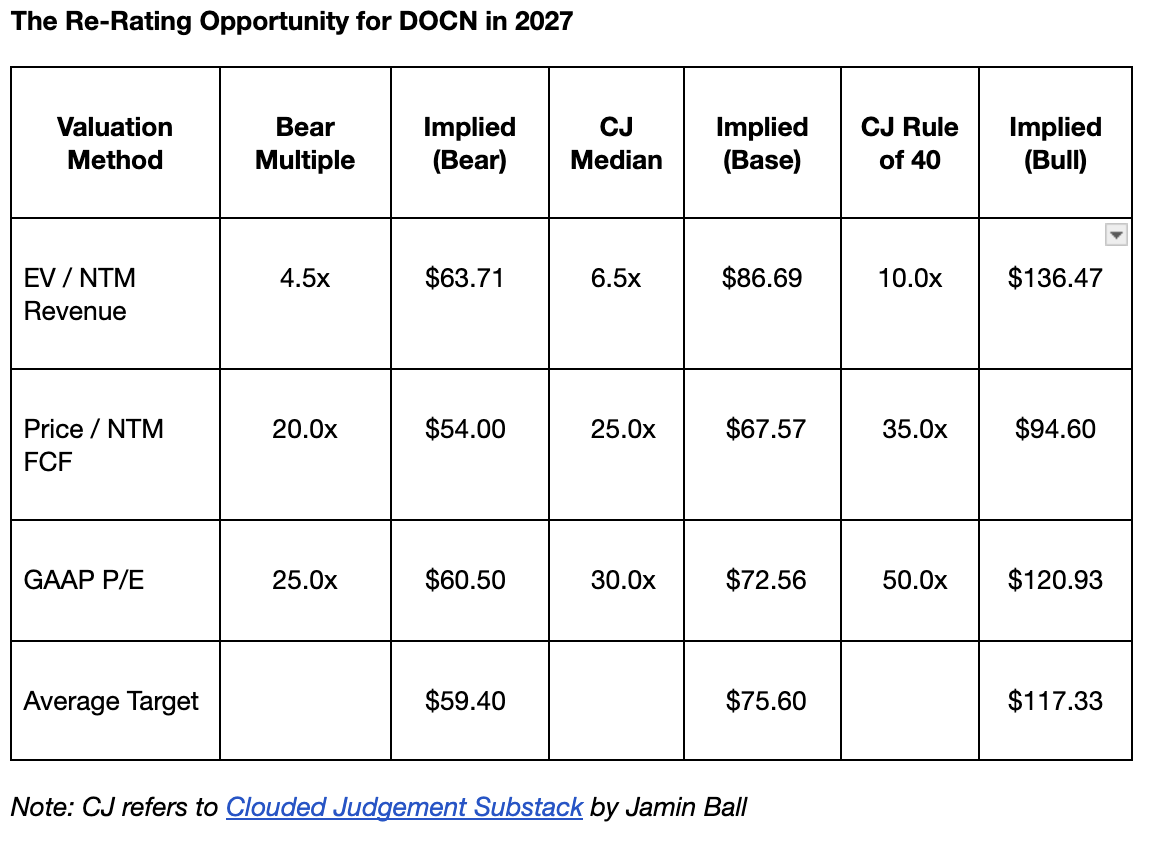
Scenario Analysis
Bear Case ($59): Execution stumbles, growth slows to 12-15%, fails to achieve Rule of 40. Valued as low-growth SaaS.
Base Case ($76): Median SaaS tier-companies like GoDaddy or Dropbox with stable, mid-teens growth.
Bull Case ($117): Rule of 40 elite tier - companies like ServiceNow or Datadog commanding 10x+ revenue multiples for efficient growth.
These scenarios imply annual appreciation of 11% (Bear), 26% (Base), and 57% (Bull) over the 2-year period to December 2027.
The M&A Wildcard
DigitalOcean's improving fundamentals and strategic positioning make it an attractive acquisition target for infrastructure players seeking to expand developer platform capabilities. Media reports throughout 2024-2025 have surfaced acquisition interest, with Betaville reporting in September 2024 that Cloudflare explored a cash-and-stock deal valued at $55 per share, though talks did not materialize. Renewed speculation emerged in October 2025, suggesting continued strategic interest from potential acquirers. For companies like Cloudflare, acquiring DOCN would provide comprehensive IaaS/PaaS capabilities, more than 640,000 customers, and complementary infrastructure to build a full-stack cloud offering. At $4.5B, such an acquisition would be strategically compelling and financially accretive for multiple potential buyers.
Tilden Path Capital's Investment in DigitalOcean
Tilden's first purchase of DigitalOcean was a relatively small position in December 2022 at ~$29. Further purchases were made in October 2023 at $24, and in May 2024 at ~$34. Additional major purchases were made in May 2025 at ~$28.
Tilden intends to be patient with this investment as the management team executes their operational turnaround, while positioning for potential upside due to possible M&A.
If you wish to discuss any of the information in this letter, please feel free to contact me at gaurav@tildenpathcapital.com.
Disclaimer
Past performance is no guarantee of future returns.
Not Investment Advice. All investing involves risk and possible loss of principal.
All charts were made with assistance from Claude.
In the analysis, we use third-party resources we believe to be reliable, but cannot guarantee the accuracy of such information. We believe the information we provide is accurate as of the date furnished, but we do not revisit past material to update it.