Who has the FIGHT? A Framework to analyze Software Disruption
The real disruption is with knowledge work — not all software companies
The LLM revolution has triggered a wave of panic about the death of software companies. The real disruption is with knowledge work, not all software companies. This post builds on our Q2 2025 analysis "Is SaaS Dead in the Age of AI?" and presents our current thinking on who gets disrupted, who doesn't (FIGHT framework), and what it means for software investors.
What Changes?
As LLMs reshape how knowledge workers operate, three things happen in sequence: knowledge worker workflows change → interfaces change → headcount shrinks — putting pressure on software built for knowledge workers, especially those with seat-based pricing models.
It starts with productivity. Thanks to LLMs, people will write software faster — a team of 10 may do the work of 50. The cost of knowledge work drops dramatically. This is not all bad news for software companies — lower headcount means better margins and less stock-based compensation, long the bane of GAAP profitability in the sector.
Software engineering won't disappear — it is likely to follow manufacturing's automation trajectory. Automotive and electronics assembly lines needed far fewer workers once automation arrived, but still required people to oversee the line, catch defects, and ensure quality. Many engineers who once wrote code may shift toward quality control, and more customization, giving rise to more 'forward deployed engineers'.
Knowledge worker workflows are going to change due to LLMs — and interfaces will follow. As AI agents take over knowledge workflows, the tools built around knowledge workflows and software engineering will face pressure. Dashboards, workflows, and reporting tools may look different or disappear. Instead of a business analyst opening a BI tool and building a dashboard, an AI agent may simply answer "which accounts had the most revenue decline this quarter?" — and surface the answer directly, without a human ever touching a tool.
Lower headcount puts pressure on per-seat pricing models. As AI agents do more of the work, pricing tied to human seats becomes harder to justify. Companies like Salesforce and Zendesk will attempt to reprice around consumption or infrastructure usage — but whether their customers accept that transition is an open question. Vendors already on consumption models — Snowflake, Twilio, AWS — are structurally better positioned for this shift.
Software Vendors Are Not Going Away. The shape and delivery of software will change dramatically — but companies will still need a single vendor to build, maintain, and support their products. When something breaks, they need someone to call. That accountability relationship doesn't disappear just because AI wrote the code. And Claude Code is still software — the delivery mechanism changes, but the need for vendors doesn't.
Not All Software Will Be Disrupted — The FIGHT Framework
Though we acknowledge we don't know the future, our research and interviews suggest that companies with one or more FIGHT characteristics are harder to displace:
F — Foundation infrastructure — too hard to replace
I — Industry-specific ERP — too embedded to rip out
G — Government-regulated software — too legally complex to swap
H — Hardware-adjacent software — too physically entangled to unwind
T — Trades and non-knowledge worker tools — too unglamorous to attract disruption attention, and still not fully digitized
Foundation Infrastructure — Operating Systems, Networking Software, and Databases — is more immune to disruption. Building a replacement requires systems that work with a wide variety of application software and scale for all manner of workloads and performance needs. These systems score extremely high on product irreplicability — one of the five factors in Tilden's Durable Growth Score — making them extraordinarily difficult to build and even harder to displace. Software already built on this foundation is unlikely to rip it out just because a new wave has arrived. New players will emerge for new use cases — but Unix and Linux (OS) and Oracle (databases) survived the cloud wave, and the same may be true for the AI wave.
Industry-specific ERP is like an operating system for a given industry. Platforms like Veeva for life sciences, Guidewire for insurance, and Procore for construction accumulate years of proprietary data — clinical trial data, claims history, project records — that are difficult to migrate and costly to recreate. The durability of this category is well established — JD Edwards, built in the 2000s, still holds significant market share in manufacturing ERP today. Even well-funded modern alternatives struggle to displace ERP incumbents. Workday, despite being a cloud-native HR platform, has not been able to fully displace PeopleSoft — a pre-SaaS system since modernized. Amazon famously struggled and gave up on migrating to Workday.
Government-regulated software has a natural moat. Payments, healthcare, and financial systems operate under strict regulatory compliance requirements. Replacing them isn't just a technical decision — it's a legal and operational one. AI disruption cannot easily overcome this.
Hardware/physical-adjacent software is resistant to displacement. Software deeply integrated with physical hardware — industrial control systems, sensors, payment terminals, or software used to manage construction projects — creates physical dependencies that are difficult to unwind regardless of how good the AI tooling gets.
Software for trades and non-knowledge workers is resistant to displacement. Plumbers, HVAC technicians, restaurant workers, and manufacturing floor operators are not seeing their jobs transformed by LLMs in the same way knowledge workers are. These are less glamorous domains that attract less disruption attention — and more importantly, the underlying work itself is not being fundamentally changed by AI.
Technology Stewardship — The Most Important Factor
The FIGHT framework — or other frameworks like "Systems of Record" — helps identify who is more likely to survive disruption, but it's a starting point, not a verdict. Ultimately, companies that innovate through disruption will win.
A telling early signal: a public Silicon Valley software company has already eliminated Jira internally, directing engineers to use AI agents to write and manage code instead. That's a company leaning into the change rather than defending the status quo. On the other side, Intel's failure to adapt to the mobile wave — despite having the resources — is a cautionary tale of execution lagging behind an inflection point.
The most critical capability right now is speed of execution — how fast a company can change its own internal workflows, adopt AI tooling, and rebuild how software gets made. This is not a strategy question; it's an execution question.
This is precisely why Technology Stewardship is one of the five factors in Tilden's Durable Growth Score — the question isn't just 'is this software hard to replace today?' — it's 'does this team have the mandate and speed to adapt before the competition does?'
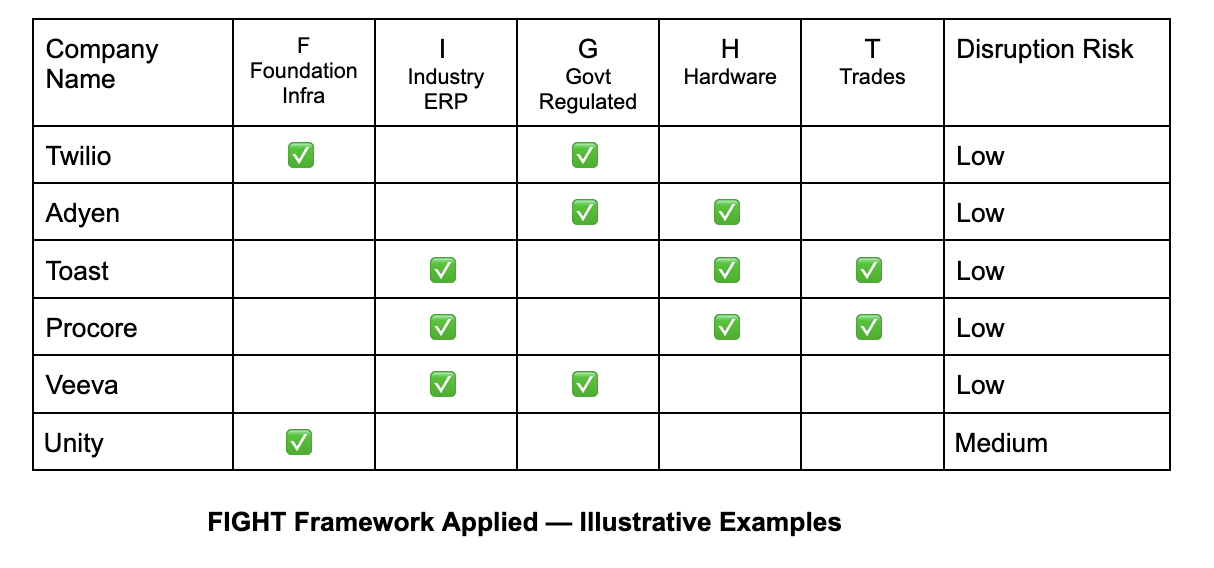
Tilden Path Capital's Durable Growth Score framework was designed from the outset to identify companies resilient to disruption. The FIGHT framework is a natural extension of that thinking, built specifically for addressing software disruption due to AI.
That said, every framework has its limits. Unity serves game developers — knowledge workers — making it more vulnerable than pure infrastructure plays, yet its game engine is foundational infrastructure that is extraordinarily difficult to replace. Veeva's regulatory moat and proprietary clinical data slow disruption significantly — but its users are ultimately knowledge workers, and AI could reshape life sciences workflows faster than expected. The FIGHT framework is a lens, not a guarantee — and should be applied with humility.
Conclusion
The AI wave will reshape software — but not all software equally. The FIGHT framework builds directly on the five factors of Tilden Path Capital's Durable Growth Score — and points to software companies with the deepest moats — foundational infrastructure, industry-specific ERP, government regulation, hardware dependencies, and trades software — as better positioned than the headlines suggest. As always, we welcome your thoughts and reactions.