$TWLO: A Call Option on Voice AI
Industry leading Communications Platform(CPaaS across voice, text, and video)
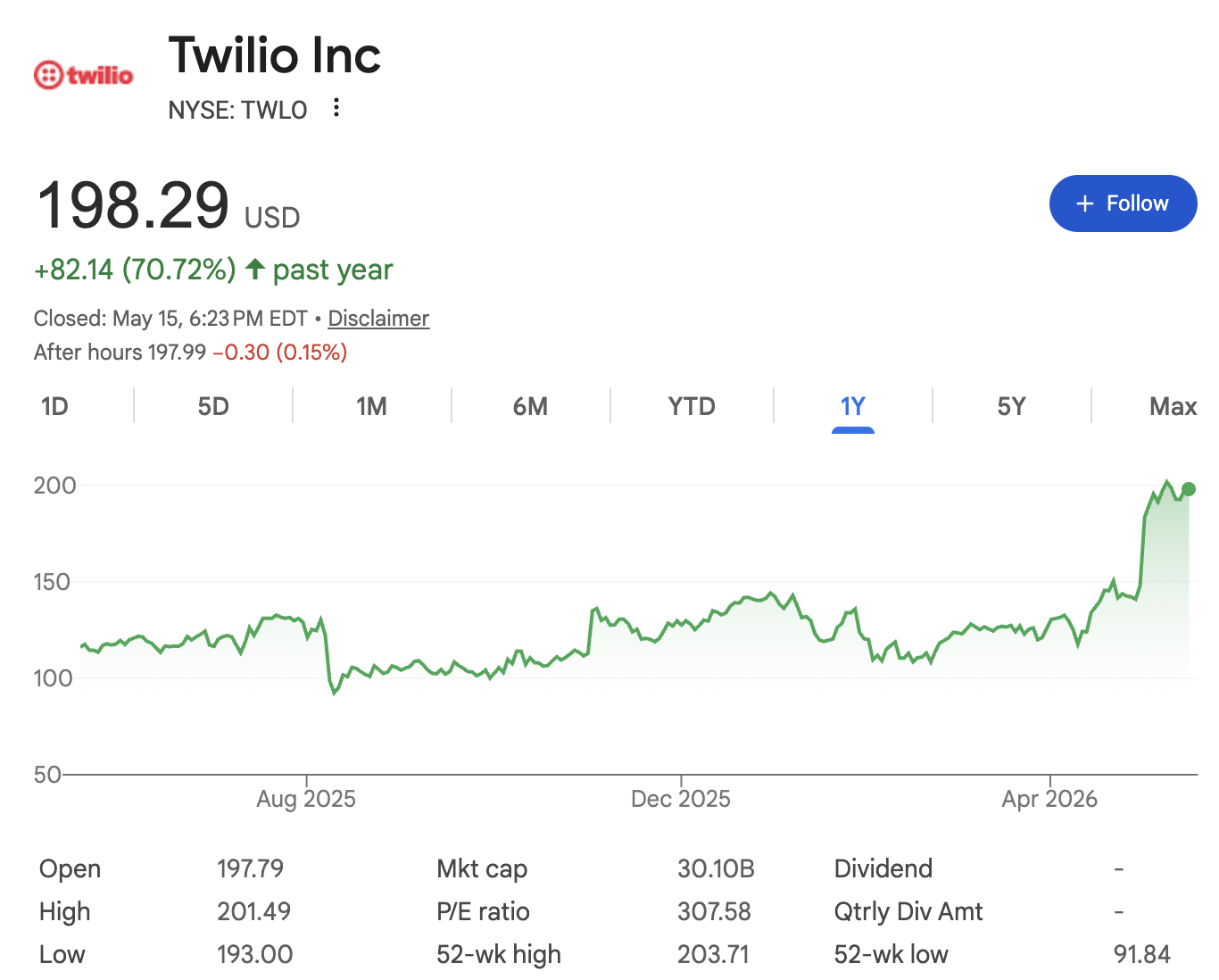
Following is an excerpt from TIlden Path’s Q4 2025 Investor Letter. Tilden's first purchase of Twilio was a relatively small position in November 2022 at approximately $45. Further purchases were made at $117 in July 2025, with additional accumulation at prices between $95 and $110 during August through October 2025.
The first leg of our thesis has played out: the market has rerated Twilio to a peer multiple as growth reaccelerated to ~15%. The next leg is whether Twilio supercharges that growth as the infrastructure layer for Voice AI.
Update since the letter: Twilio's Q1 2026 results (reported April 30) gave the first hard read on the Voice AI thesis. Voice revenue grew 20% year-over-year — its highest growth rate in 19 quarters — with Conversational Intelligence and Branded Calling each more than doubling. CEO Khozema Shipchandler told investors Twilio is seeing "unprecedented demand for voice reimagined through the lens of AI," and previewed what he called "the most consequential innovations in our company's history" — new capabilities to orchestrate context-rich conversations with persistent memory across every channel, for humans and AI agents alike.
Detailed Discussion of Portfolio Holding – Twilio
Twilio is a Communications Platform as a Service (CPaaS) built with a developer-first mindset, empowering companies to manage complex communication workflows and reach customers on their preferred channels—whether via text, email, or voice. From marketing campaigns driving customer engagement to connecting riders and drivers via in-app calling at Uber, Twilio provides the essential communications infrastructure powering these global interactions. Customers include Airbnb, Netflix, Nike, and OpenAI.
Twilio is another of Tilden Path’s turnaround investments. After explosive pandemic-era growth decelerated sharply from 48% YoY in early 2022 to a trough of 4% in Q1 2024, Twilio's revenue growth has reaccelerated to 14.6% as of Q3 2025 while operating margins have expanded meaningfully, leading to GAAP profitability. Combined with a $2 billion share buyback program, this operational turnaround has created an attractive medium-term opportunity at a relatively compressed valuation of approximately 4x EV/Sales. Finally, Twilio offers a potential strategic "pick-and-shovel" play on the AI revolution: it has emerged as critical infrastructure for the generative AI wave, providing the low-latency telephony "plumbing" required by next-generation voice agents like ElevenLabs and OpenAI—a potential long-term secular tailwind worth monitoring closely. Twilio is one of our larger positions, representing more than 5% of the portfolio.
Rating Twilio on Tilden Path Capital’s Durable Growth Score
Product/Process Irreplicability (Durable Score Weighting: 25%, Score: 4/5)
This factor measures how difficult it is for competitors to replicate Twilio's platform.
Building a Twilio competitor means solving for reliability, latency, global carrier access, and regulatory compliance. Let's take the example of ElevenLabs, a Twilio customer, which allows businesses to build and deploy conversational AI agents that can make outbound calls to customers. For ElevenLabs to build Twilio’s capabilities, they would need to solve three critical infrastructure challenges:
Global"Plumbing" Problem (Carrier Relations)
For Eleven Labs to build their own telephony stack, they will have to negotiate physical connections with thousands of local carriers globally (e.g., AT&T, Vodafone, Orange). Twilio has spent 17 years building a "Super Network"—a layer of software over these thousands of carrier deals. Eleven Labs rents this network so they don't have to hire a team of lawyers and telecom engineers to negotiate deals in 180+ countries.
Latency is the Enemy of AI Voice
For an AI voice agent to feel human, it must respond in under 1,000 milliseconds (ideally under 700ms) - a requirement that plays directly to Twilio's infrastructure advantages. Traditional phone setups require audio to 'hop' between multiple servers, causing delays that make AI sound robotic. Twilio's ConversationRelay creates a direct connection between the phone network and AI models, colocating voice services at the network edge. This allows AI agents to respond in under 500 milliseconds—within the human-normal conversational range—maintaining natural pacing. The capability requires 4,800+ global carrier relationships and edge infrastructure built over 17 years, creating a defensible technical moat.
Regulatory Compliance
But why not handle your own calls? Because telephony is a regulatory nightmare. As soon as you route voice traffic, you take on massive liability for things like mandatory e911 emergency services and complex telecom regulations like STIR/SHAKEN for caller ID authentication. On top of that, you need dedicated teams tracking global privacy laws, including GDPR and various state recording consent rules. Using Twilio is how companies offload all that legal risk—they pay Twilio to be the expert, freeing themselves to focus purely on their core AI product.
Despite competition from Vonage, Bandwidth, and Sinch, Twilio earns 4/5 for several compounding advantages: Gartner positions it as the clear CPaaS leader with the most comprehensive feature set; 10 million developers have standardized on its platform; and 17 years of carrier relationships, edge infrastructure, and regulatory expertise create barriers requiring hundreds of millions of dollars and years to replicate. The score is not 5/5 in recognition that alternatives exist.
Technology Stewardship (Durable Score Weighting: 20%, Score: 4/5)
Technology Stewardship evaluates the management’s ability to be good stewards of the company’s product and ensure it keeps innovating, navigating inflection points and keeps ahead of competition.
The Jeff Lawson Era: Vision, Ambition, but some Capital Allocation missteps
Management changes can often provide a big impetus to the company’s growth and profitability trajectory. In Twilio's case, the earlier CEO and founder Jeff Lawson was a visionary, and Twilio pioneered the developer-first, API-driven approach to communications infrastructure when others were still selling complex on-premise systems. He also helped establish Twilio’s superior developer experience and also Twilio’s massive global platform.
Despite the foundational success, the Lawson era was ultimately defined by a period of growth-at-all-costs stewardship and subsequent capital misallocation, which led to significant operational drag. The company’s growth peaked in 2022 at 42%, following a string of acquisitions - the list below covers the major ones.
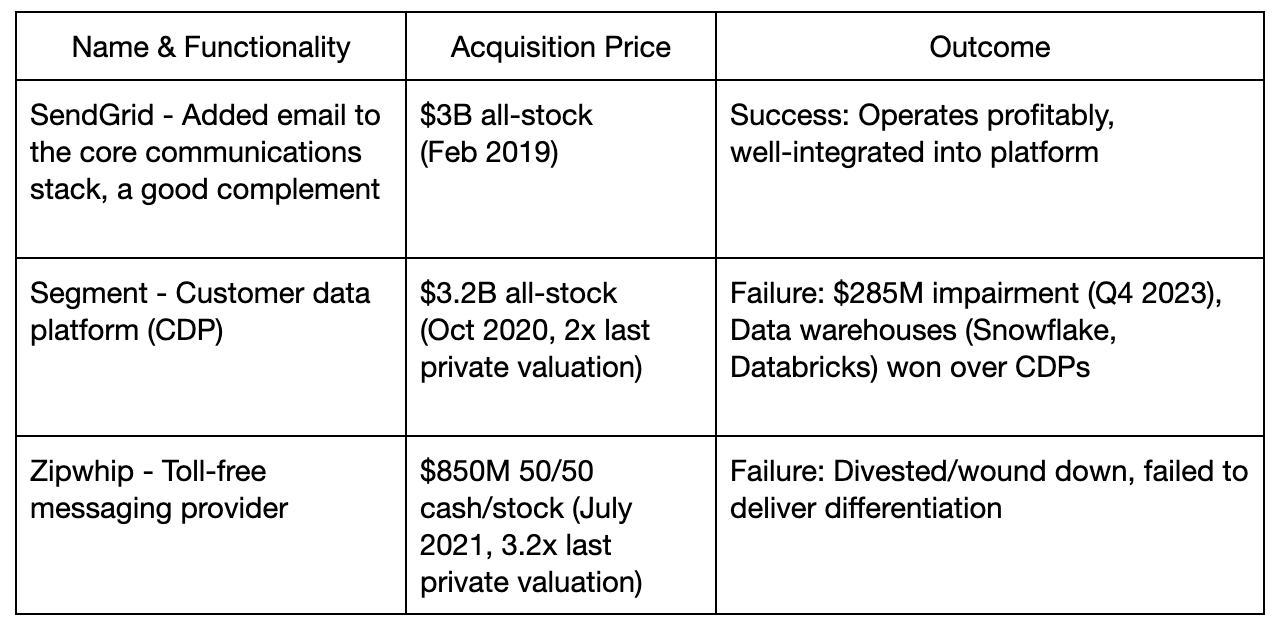
Acquisitions in the Jeff Lawson era
Khozema Shipchandler era - Focus on profitable growth, and strategic focus on AI
The new CEO, a company insider who previously served as President of Twilio Communications, took office in 2024 following activist investor pressure on prior management. He has focused on profitable growth while keeping sight of strategic inflection points like AI. Under his and the CFO's leadership, Twilio has achieved a turnaround in operating margins and reduced stock-based compensation while reaccelerating revenue growth.
Tilden Path's philosophy prioritizes product excellence over near-term financials. While we are strongly encouraged by the improving financial picture (e.g., achieving GAAP profitability), we are equally impressed by management's strategic technical stewardship.
Sound Technology Stewardship Decisions Under new CEO Shipchandler
Deciding Against Selling Segment at Fire-Sale Prices
The new management team resisted activist pressure to divest Segment at depressed valuations. While the $3.2B Segment acquisition hadn't delivered on its original promise, management made the bold choice to retain and rehabilitate the asset rather than accept a fire sale. The mandate shifted from maximizing Segment's stand-alone growth to making it profitable and integrating its data enrichment capabilities into the core Communications platform. This allows Twilio to enable more intelligent, data-driven AI experiences (e.g., highly targeted messages and personalized voice flows) for customers using their existing platform.
Resisting short-term activist pressure in favor of a product-driven decision that protects long-term shareholder value and maximizes the utility of a sunk investment aligns directly with Tilden Path's investment philosophy.
Strategic Investment in Voice AI Capabilities
Under Shipchandler's leadership, Twilio is leveraging its carrier advantage to become the default communications backbone for the AI industry.
Solving Latency: Twilio launched ConversationRelay in 2024, solving the critical latency problem for AI voice agents by achieving sub-500ms response times. This proprietary infrastructure uniquely positions Twilio to capture the high-growth voice AI market.
Expanding Ecosystem: This infrastructure focus is supported by strategic alliances, including a multi-year partnership with Microsoft (May 2025), granting Twilio access to thousands of Microsoft enterprise customers while integrating Azure AI capabilities into its platform. Management has also integrated leading AI voice providers, including ElevenLabs and Google, to ensure best-in-class model availability.
This demonstrates a clear, forward-looking technical stewardship—recognizing that Twilio's low-latency, highly compliant infrastructure is the structural moat necessary for the next generation of conversational AI applications.
Focus on small tuck-in acquisitions to improve the product
In contrast to Lawson's billion-dollar acquisitions at market peaks, Shipchandler has pursued small, strategic tuck-in deals that augment core capabilities. In October 2025, Twilio acquired Stytch, a developer-focused identity platform for AI agents, for an undisclosed amount. The acquisition addresses a critical need: authenticating and distinguishing between humans, trusted AI agents, and rogue agents—strengthening Twilio's position in the AI agent space without the integration distraction of large deals.
This disciplined approach aligns with Tilden Path's preference for small tuck-in acquisitions that enhance the core product versus taking the challenge of integrating large technology acquisitions which often do not end well.
The new management's technology stewardship demonstrates that effective stewardship doesn't require flashy new products or large acquisitions—just disciplined investment in the right strategic areas, which aligns with Tilden's preference for disciplined focus on innovation.
Other Factors of Tilden Path’s Durable Growth Score
Other Durable Growth Score factors for Twilio include switching costs (Weighting: 25%, Score: 3.5/5), ecosystem strength (Weighting: 15%, Score: 4/5), and customer experience (15%, 4). Taken together, these result in a weighted average score of 3.88/5 — a slightly lower than top-quartile result. However, Twilio’s improving financial picture presents a medium-term attractive opportunity.
Rating Twilio’s Financial Metrics
In this section, we explore Twilio's improving financial metrics including revenue growth, improving margins, and better capital allocation.
Twilio’s Revenue Growth is Re-accelerating
As you can see from the chart below, Twilio's revenue growth is recovering from the trough growth rate of 4% set in Q1 2024, when the new management took charge in January 2024.
The growth has been driven by strength in the core product, led by high teens growth in the core Messaging product and a return to double-digit growth in Voice for the first time in over two years. This is supported by an increasing Dollar-Based Net Expansion Rate (DBNER of 109% in Q3 2025) and significant large deal activity, reflecting better cross-selling and multi-product adoption among enterprise and ISV customers. From Q3 2025 earnings call: “Finally, from a sales channel perspective, we saw continued strength from both ISVs and self-serve customers, evidenced by 20% plus year-over-year revenue growth from both.”
Here is Twilio’s CFO in Q3 2025 earnings call: “Voice revenue growth accelerated to the mid-teens, its fastest growth rate in over three years. This was aided by strong growth from voice AI customers, which accelerated to nearly 60% year-over-year. In addition, revenue from our 10 largest voice AI start-up customers increased more than 10x year-over-year.”
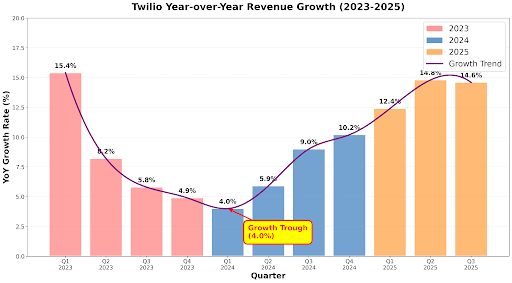
Twilio’s Revenue Growth is on an uptrend
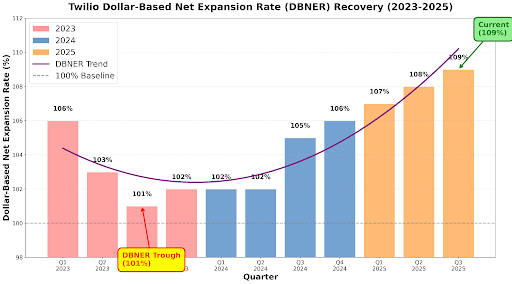
Net Expansion rate has recovered from post-pandemic lows
Twilio’s improving operating margins
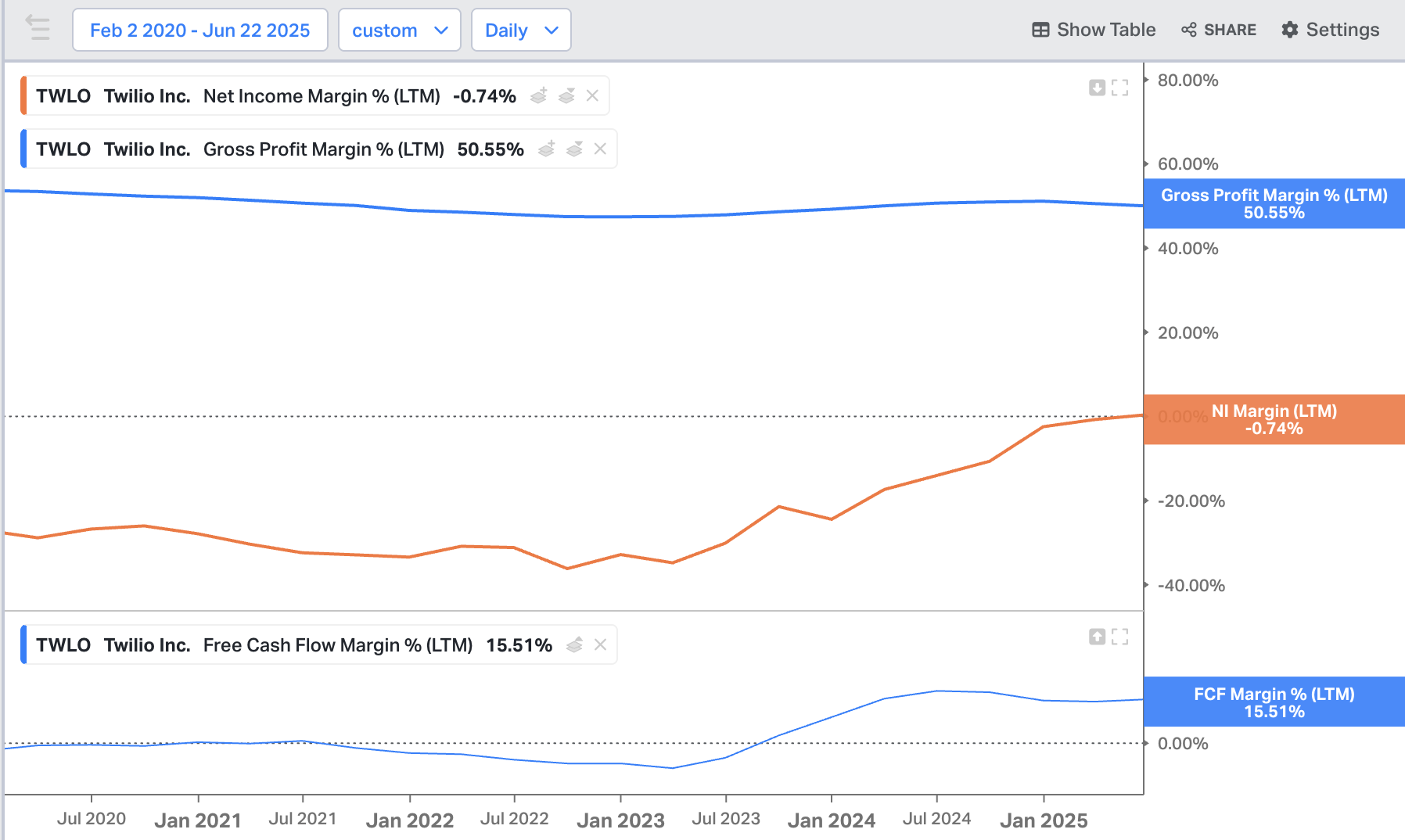
Twilio has achieved significant operating margin expansion through disciplined cost management and operational efficiency. After years of significant GAAP operating losses (reaching negative 33.6% in Q4 2023), the company successfully reversed its financial trajectory, achieving a 1.37% GAAP net income margin for the last twelve months as of Q3 2025. This improvement has been driven by several factors: aggressive headcount reductions (over 40% of employees laid off in 2022-2023), improved automation and workforce planning, and a shift in resources towards the core business and reduced focus on Segment.
Twilio Targets 15-20% Share Buyback While Cutting SBC
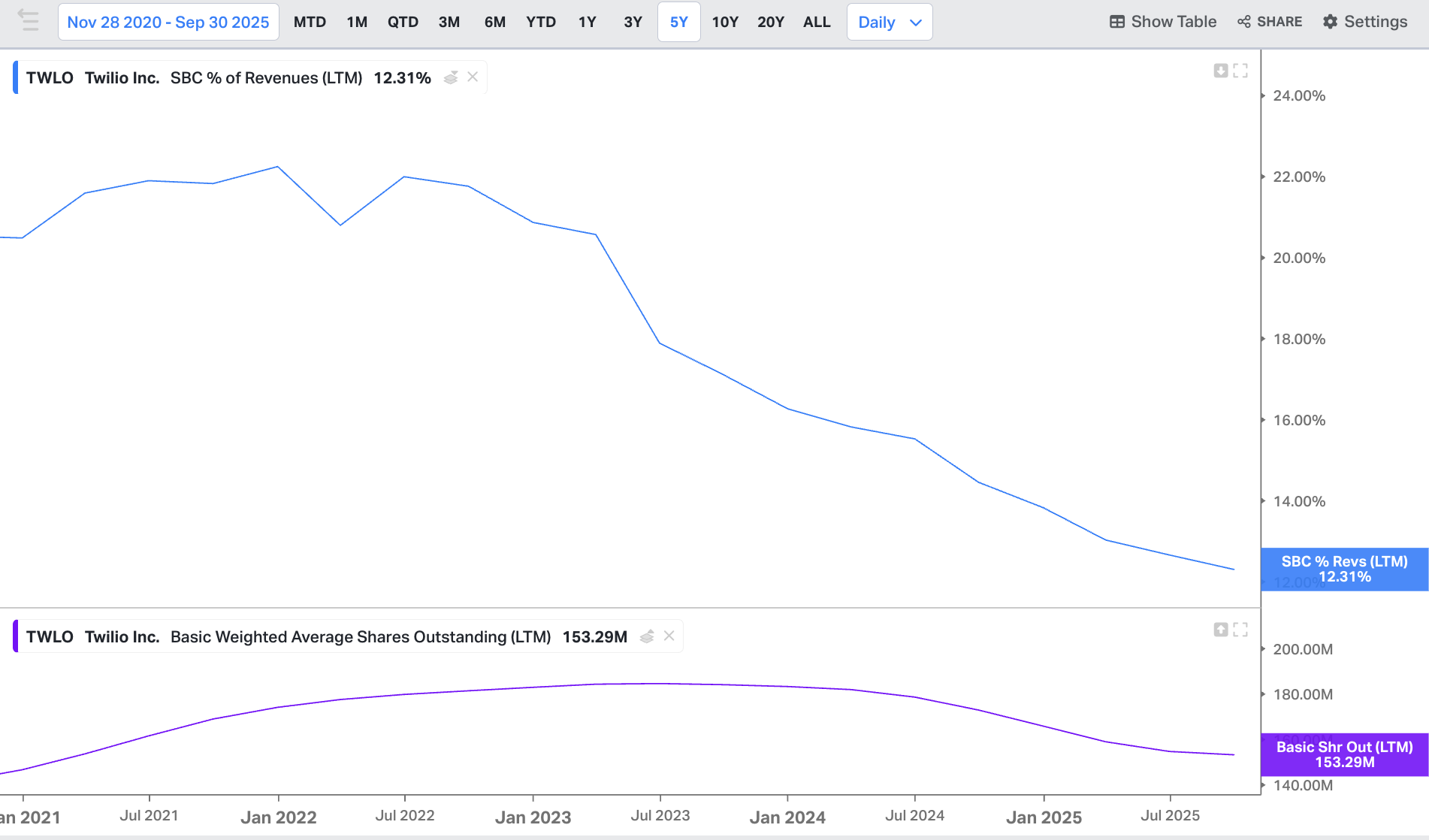
Furthermore, the commitment to shareholder return is clear through capital stewardship: management has aggressively reduced stock-based compensation (SBC) as a percentage of revenue (declining from 20% in Q1 2023 to 12% in Q3 2025). Twilio has been active in share repurchases—the company completed $3 billion in buybacks between 2023 and 2024 under previous programs, and in January 2025 authorized an additional $2 billion program (expiring December 2027). These buybacks are highly material—representing roughly 15-20% of Twilio's market capitalization—and signal management's confidence in the business transformation while actively reducing share count and returning tangible value to shareholders.
Valuation: Attractive if Twilio’s growth continues upward trajectory
Twilio's current valuation appears highly compelling when benchmarked against Jamin Ball's Clouded Judgement SaaS data, suggesting the market is overlooking its financial transformation. At an EV/Sales ratio of approximately 3.7x (reflecting a current Enterprise Value of ~$19 billion), Twilio trades at a steep 38%-43% discount to the median mid-growth public SaaS multiple of 6x-7x, despite generating organic growth of 13-15%.
The value proposition becomes even more attractive when viewing cash flow: with projected $920–930M in 2025 Free Cash Flow (an 18.5% FCF margin), the company trades at approximately 20-21x EV/FCF, a significant premium to its past self, but still well below the Clouded Judgement median of ~40x for FCF-positive peers. While the discount is partially attributable to lower gross margins (~50%), the magnitude of the valuation gap appears excessive given the company's improving fundamentals: reaccelerating growth, expanding operating margins (targeting 21-22% by 2027), and robust cash generation.
Estimates for Twilio’s Income Statements
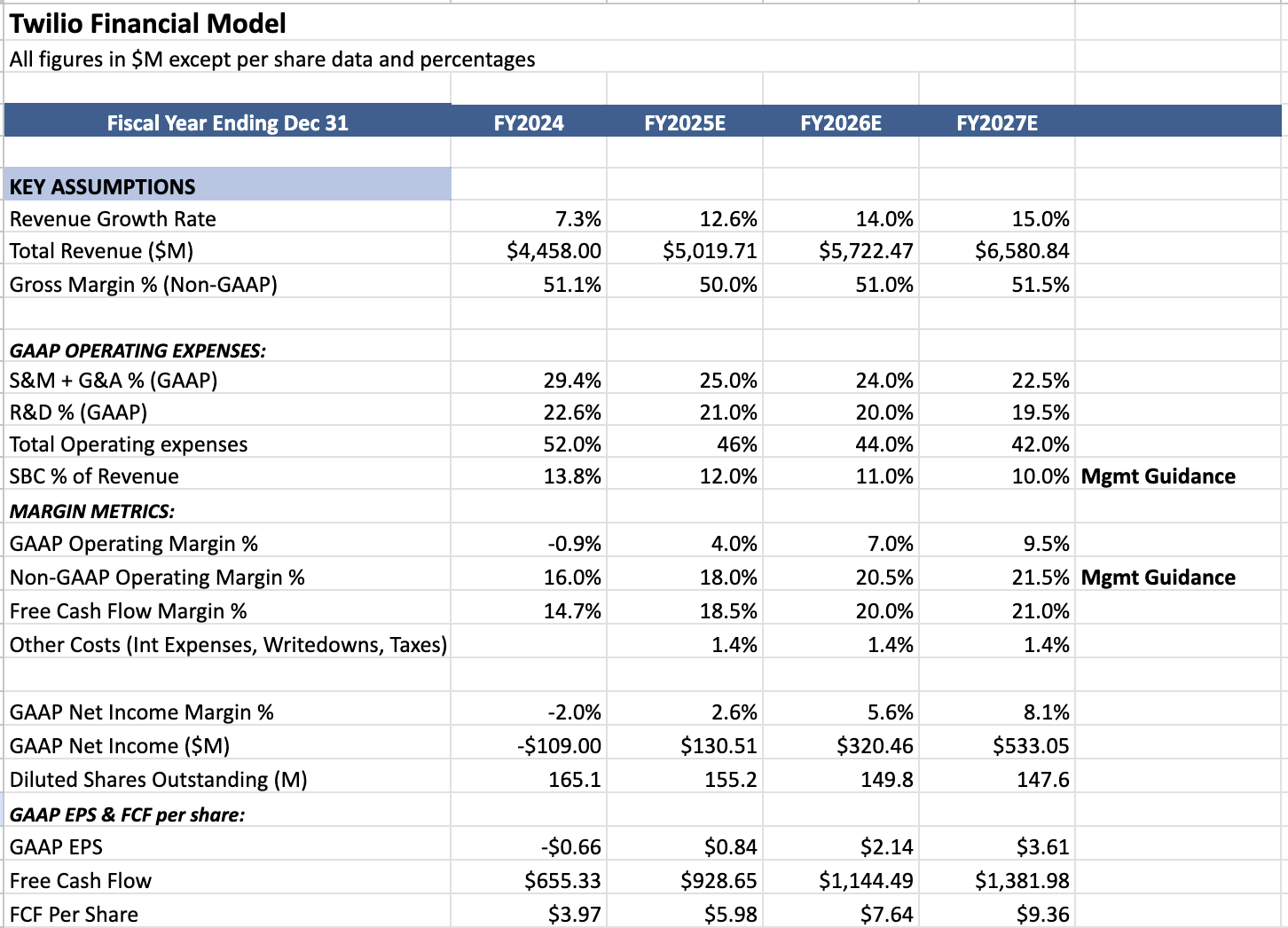
The financial model below reflects base case estimates for Twilio's revenue growth accelerating to 14% in 2026, 15% in 2027, and 15% in 2028. Management has guided to double-digit growth over time, and given that Twilio has achieved greater than 14% growth over the last two quarters, Tilden's view is that this growth trajectory is readily achievable.
2027 Financial Targets
In January 2025, during Twilio’s investor day, management guided to the following framework
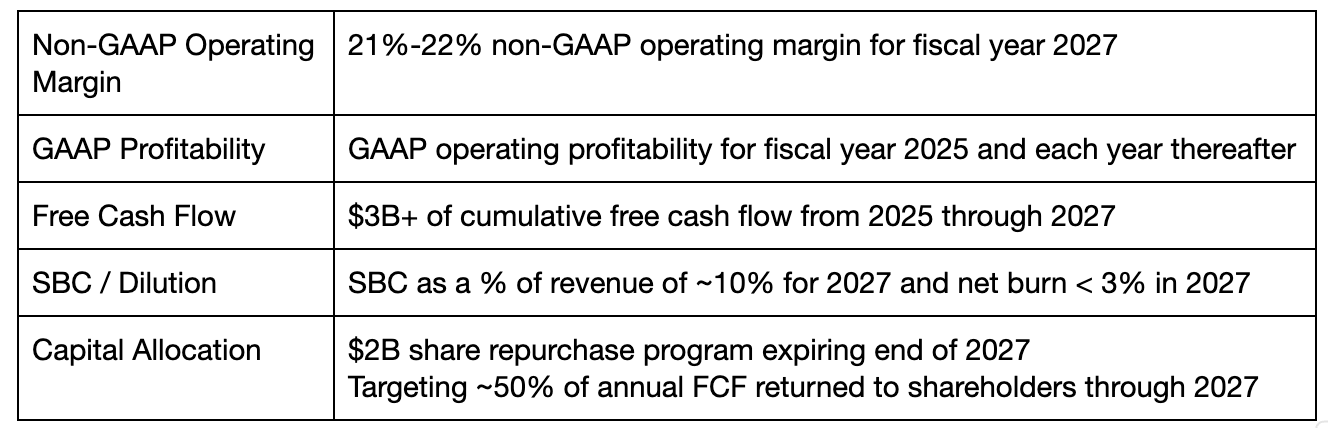
We estimate Twilio will achieve:
GAAP Net Income Margin: 8.1% in 2027
Free Cash Flow Margin: 21% in 2027
Shares Outstanding: 147.6M in 2027 (down from 155.2M in 2025)
This share count reduction reflects Twilio's existing $2B share repurchase program that expires at the end of 2027, representing approximately 7% dilution offset.
Valuation Framework (2027 Using 2028 NTM Revenue)
2027 Revenue: $6.6B
2028 NTM Revenue: $7.6B (15% growth)
2027 Share Count: 147.6M
Current Stock Price: $140
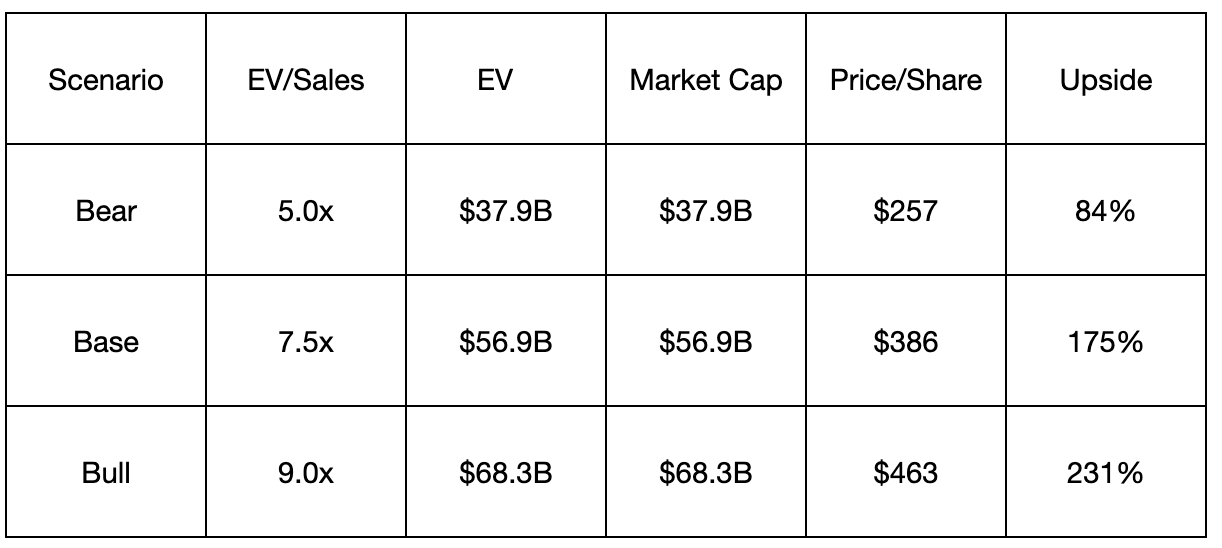
Valuation Scenarios (Bear, Base, Bull)
At the midpoint EV/Sales of 7.5x, which aligns favorably with Clouded Judgement's benchmark multiple for mid-growth companies (~15% growth), we arrive at Twilio's enterprise value of approximately $56.9B in 2027 based on 2028 revenue of $7.6B (15% growth vs 2027), translating to a stock price of $386 – representing ~175% upside from current levels.
AI Voice: The Call Option
AI voice application adoption may accelerate significantly. According to Twilio, 90% of the top 50 AI startups are building with Twilio. If AI voice adoption takes off as expected, Twilio's premier position in AI voice infrastructure represents a substantial call option on the company's growth trajectory beyond our base case estimates.
Tilden Path Capital's Investment in Twilio
Tilden's first purchase of Twilio was a relatively small position in November 2022 at approximately $45. Further purchases were made at $117 in July 2025, with additional accumulation at prices between $95 and $110 during August through October 2025.
Tilden intends to be patient with this investment as the management team executes their operational turnaround, while positioning for potential upside if Twilio becomes a significant winner in the AI voice applications ecosystem.
If you wish to discuss any of the information in this letter, please feel free to contact me at gaurav@tildenpathcapital.com.
—----------------
Disclaimer
Past performance is no guarantee of future returns.
Not Investment Advice. All investing involves risk and possible loss of principal.
In the analysis, we use third-party resources we believe to be reliable, but cannot guarantee the accuracy of such information. We believe the information we provide is accurate as of the date furnished, but we do not revisit past material to update it.
All charts were made with assistance from Claude.